
Life Sciences in Winston-Salem: Fueling the Future
Boasting heavy hitters like Atrium Health Wake Forest Baptist, Novant Health, Wake Forest University School of Medicine and a host of innovative established and startup companies, Greater Winston-Salem punches above its weight in the life sciences sector.
Innovation Quarter Delivers Big Impact
In the center of it all is the Innovation Quarter, home to more than 170 companies and one of the fastest growing urban innovation districts in the country. In 2022, its overall economic impact on the region was greater than $1.6 billion.
Now, the Innovation Quarter is embarking on Phase 2, adding 1 million square feet of new office, lab and retail space and 15 additional acres of urban green space, essentially doubling its current size and placing it at No. 7 nationally for life sciences space under development.
“We are a place for all – from entrepreneurship or startups to mature company expansion,” says Jason Kaplan, the Innovation Quarter’s associate vice president for operations. “Academic and clinical components drive a lot of our activity in identifying companies with ideas that can come here and take it, as we say, from discovery to delivery.”
Kaplan says the Innovation Quarter now and with the coming expansion is focused on resources needed to facilitate new ideas.
“We’re part of the third-largest academic health and learning system in the country,” he says, “offering space that will let you do what you need to do – lab, office or coworking space or build-to-suit options.” He says Phase 2 will prepare for the future growth that’s knocking at the door.
“Allowing for expansion of programs, like Wake Forest School of Medicine, will bring more jobs, which brings more innovation, which brings more companies. It’s a multiplying effect,” he says.
The Innovation Quarter is also a place where people can live, learn, play and shop. Bailey Park, described as the “living room” of the Innovation Quarter, hosts community events and celebrations, and the adjacent 1.7-mile Long Branch Trail connects throughout to the larger greenway system.
“It’s a place for people to come together when that can’t always happen within a building,” Kaplan says.
Wake Forest Institute for Regenerative Medicine
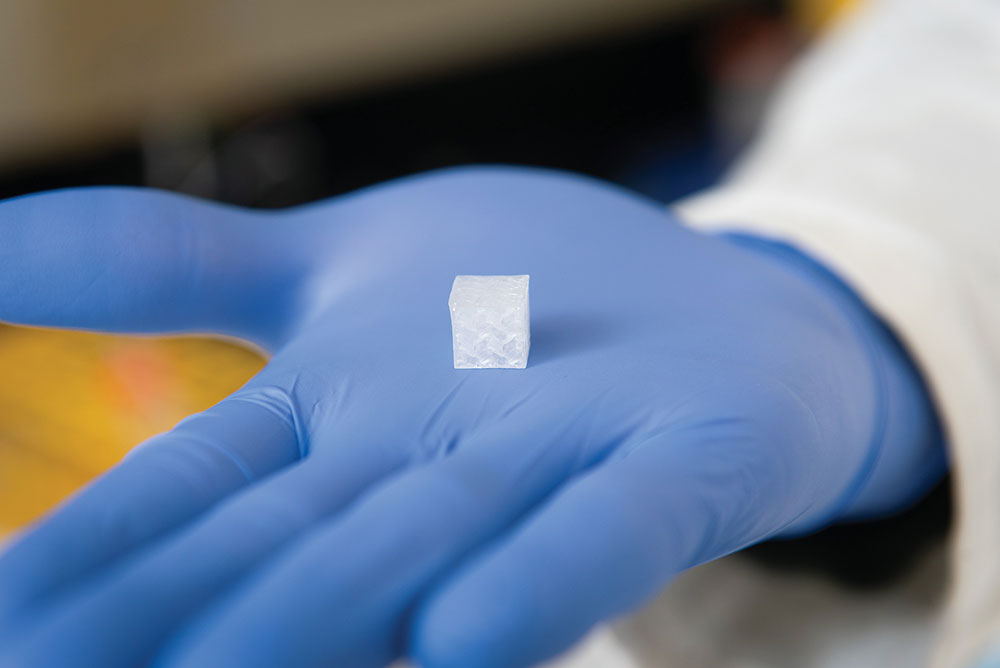
The National Science Foundation’s quest to create regional innovation engines found fertile ground in the Innovation Quarter with the Wake Forest Institute for Regenerative Medicine (WFIRM) and its network of academic, government and industry partners. WFIRM is the world’s largest institute for regenerative medicine research.
Dr. Anthony Atala, director, says beyond research, WFIRM has focused on scaling up for regenerative medicine manufacturing. A test bed offers free space where both startup and established companies develop prototypes to test ideas on equipment donated by manufacturers, and what was first called an incubator has been renamed an accelerator.
“We also have a workforce development program,” Atala says, “because if you bring companies here, you need to train people who can work here.”
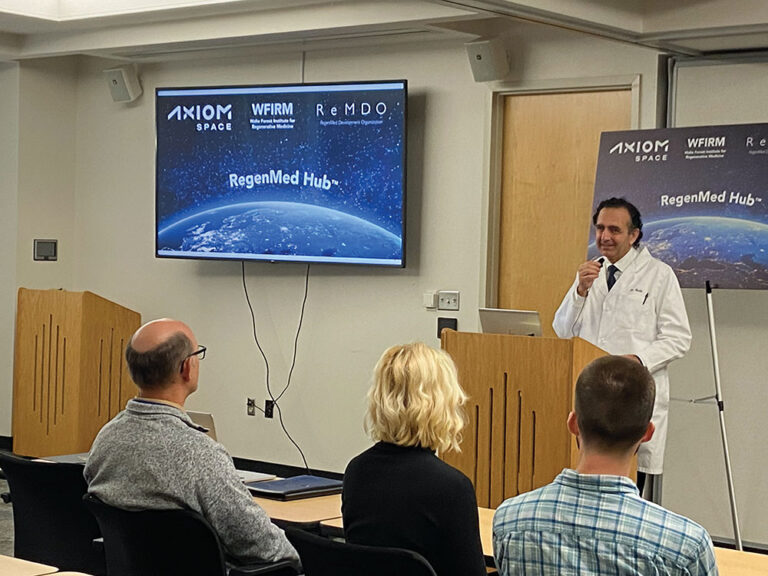
WFIRM and the RegenMed Development Organization (ReMDO) announced the creation of a new program called the RegenMed Clinical Trials Catalyst in 2023.
“The No. 1 challenge for companies is that once you manufacture the product, you need to recruit patients for clinical trials to use the product,” Atala says. “We offer a one-stop shop with our network of 67 hospitals through Advocate and Atrium, where we can access a large patient base.”

Education, Careers & Opportunity
Winston-Salem Development to Transform Wake Forest Area
Major mixed-use project will enhance economic activity near the university.
Bright Future Ahead for Life Sciences in Winston-Salem
With all this in place, WFIRM and ReMDO leveraged existing partnerships with neighboring North Carolina Agricultural and Technical State University, Winston- Salem State University, Forsyth Technical Community College and a network of community colleges to apply for the NSF grant. From more than 700 applicants, they were selected as one of 10 winners nationwide to become the NSF-Piedmont Triad Regenerative Medicine Engine, initially receiving up to $15 million for two years and up to $160 million over 10 years.
Atala says, “We will be able to transfer some projects at WFIRM to these other institutions for the final process development to take them to commercialization. We will have community college, undergraduate and graduate students working on these projects, expanding our workforce development.”
He says the grant for the Regenerative Medicine Engine allows the addition of a program to help companies navigate the complex regulatory environment for regenerative medicine. Additionally, the Regenerative Medicine Engine has announced at least five grant opportunities of up to $500,000 per project for companies already in the region or hoping to move here.
Get to Know Winston-Salem
Want to learn more about living and working in Winston-Salem, North Carolina? Check out the latest edition of Livability Greater Winston-Salem.