

Historic Downtown Concord, NC: Walkable Historic Living Along Union Street
Historic Downtown Concord combines the city’s traditional commercial core with the historic residential districts surrounding it. North Union Street, South Union Street and Edgewood contain some of Concord’s most architecturally distinctive homes. At the same time, nearby Union Street provides access to restaurants, shops, arts venues, civic buildings and community events.
The neighborhood’s defining feature is its layered development. Century-old houses, mature trees and traditional storefronts sit alongside renovated public spaces and newer downtown businesses. Residents gain a walkable connection to Concord’s cultural center without giving up the quieter residential character found on surrounding side streets.
Overall Vibe and Lifestyle
Life in Historic Downtown Concord feels connected to the city’s daily activity. Residents can walk to coffee shops, restaurants, galleries, performances and government services, giving the neighborhood a more public and spontaneous rhythm than a conventional subdivision.
The atmosphere changes by block. Homes close to Union Street experience more pedestrian activity, courthouse traffic, and downtown events. North and South Union streets retain a formal historic character, while Edgewood and nearby side streets generally feel quieter and more residential.
The neighborhood is likely to suit residents who value architectural individuality, local businesses and walkable cultural amenities. It offers less uniformity than a master-planned community and no private recreation complex, but its public spaces and downtown programming create their own community infrastructure.
Walkability and Mobility
Historic Downtown Concord offers practical walkability within the commercial core. Residential streets connect directly to Union Street, public buildings, arts venues, restaurants and small businesses. Recent streetscape improvements added wider sidewalks, updated lighting and space for outdoor dining.
The neighborhood also supports recreational walking. Concord’s approximately four-mile Downtown Greenway Loop combines paved trails and city sidewalks, connecting downtown with the McEachern Greenway, McGee Park and Les Myers Park.
A vehicle is still useful for full grocery trips, specialized medical care and destinations outside central Concord. Event schedules can temporarily change parking demand and traffic circulation, particularly during festivals, parades and courthouse-related activity.
Natural and Built Environment
Tree-lined streets and established residential landscaping distinguish the historic districts from newer parts of Concord. Large oaks, magnolias and mature foundation plantings create shade and reinforce the area’s settled appearance.
Lot sizes and setbacks vary. Some cottages and bungalows occupy compact urban parcels, while larger Union Street residences sit on formal grounds with deeper lawns and substantial landscaping. This variation reflects the neighborhood’s gradual development rather than a single subdivision plan.
The commercial core has a denser built form, with historic storefronts and civic buildings positioned close to the sidewalk. Nearby residential streets transition quickly to porches, lawns, and detached houses.
Memorial Garden provides one of downtown’s most distinctive green spaces. The three acre garden includes flagstone paths, water features, mature plantings and seasonal displays within walking distance of Union Street.
Design and Architecture
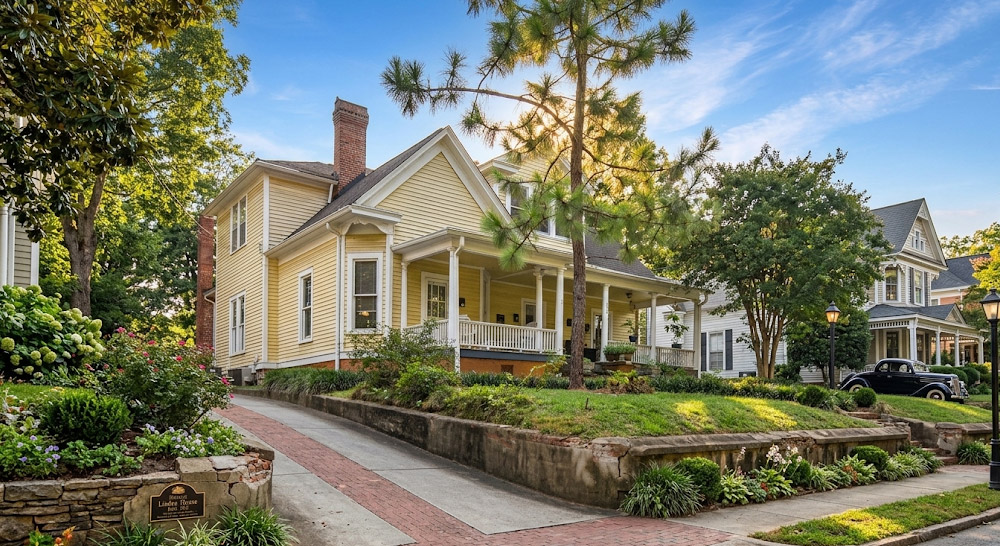
Architecture is the neighborhood’s defining physical feature. Homes date from the 19th century through the mid-20th century, with some earlier structures and later infill. The result is a varied streetscape rather than a district representing a single period.
Queen Anne houses may feature asymmetrical facades, projecting bays, decorative trim and wraparound porches. Colonial Revival properties typically have more balanced elevations and formal entrances. The historic districts also contain Italianate, Greek Revival, Gothic Revival, Craftsman, bungalow and English cottage influences.
Interior layouts vary as much as the exteriors. Larger homes may retain formal parlors, dining rooms, fireplaces, tall windows and original millwork. Smaller cottages and bungalows generally have more compact plans, while renovated properties may incorporate open kitchens and contemporary living spaces within their historic footprints.
Housing at a Glance
| Metric | Description |
|---|---|
| Property types | Detached historic houses, cottages, bungalows and limited infill or converted residences |
| Construction period | Primarily 19th century through mid-20th century |
| Common styles | Queen Anne, Colonial Revival, Italianate, Craftsman, bungalow and cottage designs |
| Typical features | Front porches, hardwood floors, fireplaces, original millwork and varied lot sizes |
| Community structure | No conventional HOA; city historic preservation standards apply within designated districts |
Real Estate Snapshot
Historic Downtown Concord’s housing market is driven by architectural character and proximity to downtown. Available properties may range from large Union Street residences to compact cottages, bungalows and renovated infill.
Because houses were built across multiple eras, directly comparable properties can be difficult to find. Condition, restoration quality, original details, lot size and location within or outside a locally designated historic district all shape relative value.
Inventory is resale-based and irregular. The neighborhood does not produce the predictable selection of similar floor plans found in a large subdivision, and individual houses may appeal to different priorities depending on their scale and level of renovation.
| Metric | Summary |
|---|---|
| Market demand | Supported by architectural character, walkability and downtown access |
| Inventory | Limited, irregular and primarily resale-based |
| Housing range | Grand historic residences, traditional detached houses, cottages, bungalows and limited infill |
| Pricing context | Influenced by condition, restoration quality, lot size, architectural detail and district location |
| Ownership considerations | Historic-preservation standards, variable parking and property-specific maintenance needs |
Amenities and Local Conveniences
Union Street is the neighborhood’s primary gathering and commercial corridor. Independent restaurants, coffee shops, taprooms, boutiques and professional services occupy the compact downtown core. Concord’s social district allows approved beverages purchased from participating businesses to be carried within designated boundaries.
The Cabarrus Arts Council operates the Davis Theatre and The Galleries in the restored 1876 courthouse. The galleries offer rotating visual-art exhibitions, while the intimate theater hosts live music and other performances. Public art and recurring events extend the arts presence beyond the building.
Downtown festivals, art walks, holiday events and civic gatherings regularly bring visitors into the district. This programming creates activity close to home, although houses nearest the commercial core experience more event-related traffic.
Memorial Garden offers a quiet counterpoint to Union Street, while the Downtown Greenway Loop provides a longer walking and cycling route. Les Myers Park and McGee Park add public recreation beyond the immediate business district.
Gibson Mill is a short drive from downtown and complements the neighborhood with a food hall, breweries, an antique marketplace and event space. Atrium Health Cabarrus and surrounding medical offices provide hospital and outpatient care close to the district.
Schools and Education
Cabarrus County Schools serve Historic Downtown Concord. Depending on the exact historic district and street, likely elementary assignments may include Coltrane-Webb STEM Elementary School, R. Brown McAllister Elementary School or W.M. Irvin Elementary School, followed by Concord Middle School and Concord High School. Families should confirm the exact property through the district’s Find My School tool, as attendance boundaries can change.
The district also offers application-based STEM, career and other Program Choice pathways. Private and charter schools are available throughout Concord, while Rowan-Cabarrus Community College provides nearby higher-education and workforce programs.
Commuting and Location
Historic Downtown Concord is centered near Union Street and Cabarrus Avenue. Local streets connect the district with Church Street, U.S. Highway 601, Concord Parkway and I-85, although regional trips begin on surface roads.
Drive times vary with traffic, construction, weather, downtown events and the property’s exact location.
| Destination | Approximate Drive Time |
|---|---|
| Union Street commercial district | Walkable or 2–5 minutes |
| Gibson Mill | 5–10 minutes |
| Atrium Health Cabarrus | 5–10 minutes |
| I-85 | 10–15 minutes |
| Uptown Charlotte | 30–50 minutes |
| Charlotte Douglas International Airport | 40–60 minutes |
Downtown’s central Concord location is particularly convenient for local government, healthcare and businesses in the city center. Commuting to Charlotte is feasible but more traffic-dependent than travel from western Concord neighborhoods closer to the interstate.
Map of Things To Do in Historic Downtown Concord, Concord
Quirks and Perks
Historic Downtown Concord’s greatest perk is its architectural range. Queen Anne houses, formal Colonial Revival residences, Craftsman bungalows and modest cottages coexist within a few blocks, creating a streetscape that cannot be reproduced by new construction.
The proximity to downtown is another defining advantage. Residents can walk to performances, exhibitions, restaurants and public events while still living on residential streets with mature trees and front porches.
That access comes with a trade-off. Festivals, parades and civic activity can produce temporary traffic, noise and parking competition. Conditions vary considerably between a house near the Union Street core and one deeper within Edgewood or a residential side street.
Neighborhood Logistics
A conventional neighborhood homeowners association does not govern Historic Downtown Concord. Properties within the locally designated North Union Street, South Union Street and Edgewood historic districts fall under the city’s preservation standards.
Certain exterior alterations require review by the Historic Preservation Commission and a Certificate of Appropriateness. These standards help protect the district’s architectural character while shaping how visible additions and modifications are completed.
Parking arrangements vary by property and block. Some houses have private driveways or rear garages, while denser locations near the commercial core rely more heavily on on-street or shared parking.
Explore Concord Neighborhoods
Note on imagery: Images marked “AI Generated” are visuals to illustrate the neighborhood homes, atmosphere and architectural style. To protect homeowner privacy, these images are artistic representations and do not depict specific existing properties.