
A Tale of Three Cities: How 3 Indiana Towns Transformed Their Waterfront
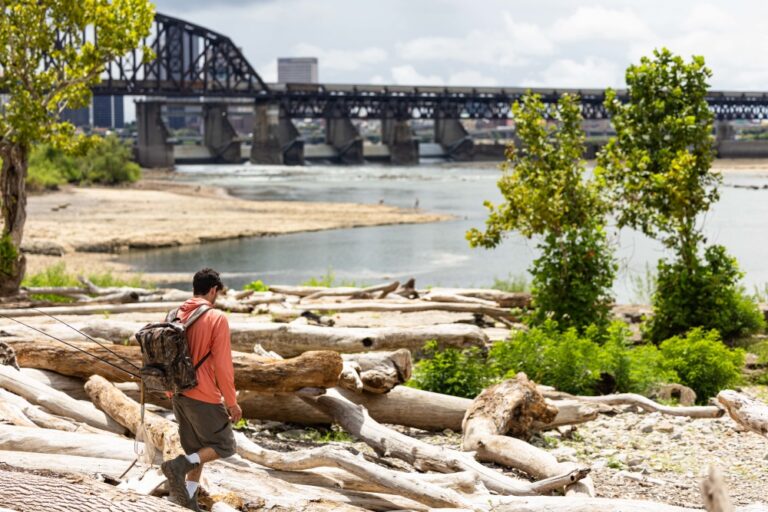
What happens when three independent towns decide to build a shared future? You get a vibrant new riverfront region with a distinct identity all its own.
By working together, leaders from Clarksville, New Albany and Jeffersonville created the Ohio River Greenway – a scenic 7.5-mile paved trail that hugs the water’s edge and connects all three communities. To expand their reach, they linked this shoreline directly to downtown Louisville via the Big Four Bridge, a majestic former railroad span transformed into a milelong pedestrian and bicycle crossing.
Where industrial factories once stood, the Greenway has completely revitalized the waterfront into a thriving destination where modern residential and retail spaces mingle with bustling restaurants, boutique shops and an outdoor amphitheater.
Here is how each town uniquely reimagined its piece of the shoreline.
In This Article
Clarksville
The town’s most ambitious project is the Clockworks, a $500 million redevelopment of the former Colgate-Palmolive plant complex. Plans for the 57-acre site include hotels, apartments and shops, all centered around the site’s famous 38-foot clock. Construction is expected to start in early 2027.
While the town looks toward the future, visitors can step back millions of years at the neighboring Falls of the Ohio State Park. The park features fossil beds that are 390 million years old and stand as the largest exposed Devonian fossil beds in the world, predating even the dinosaurs. Walking directly on the expansive limestone rock allows visitors to look down and see ancient marine invertebrates and primitive fish preserved exactly where they fossilized.
“It’s neat,” says Tammi Gibson, economic development director for the Town of Clarksville. “It’s an interactive museum of history, and you can walk right through it.”
For hiking or biking, the area also offers excellent access to a variety of trails. The Clarksville Discovery Trail is a 1.9-mile path that connects directly to the larger Ohio River Greenway and links all three communities.
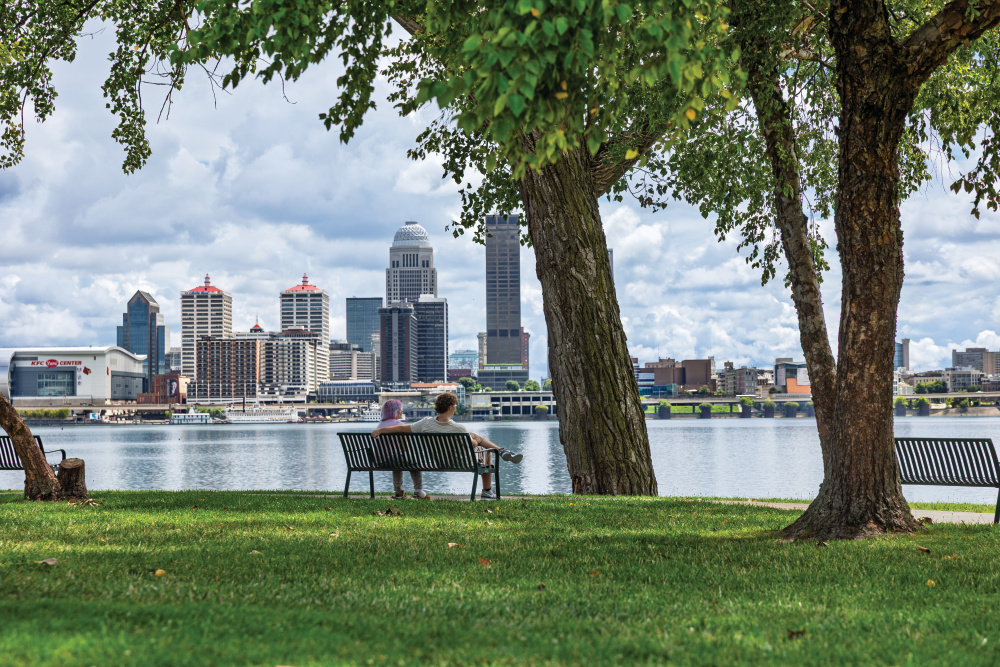
Beyond the convenience, the location offers a major visual perk: “We probably have the best views of Louisville,” Gibson says.
New Albany
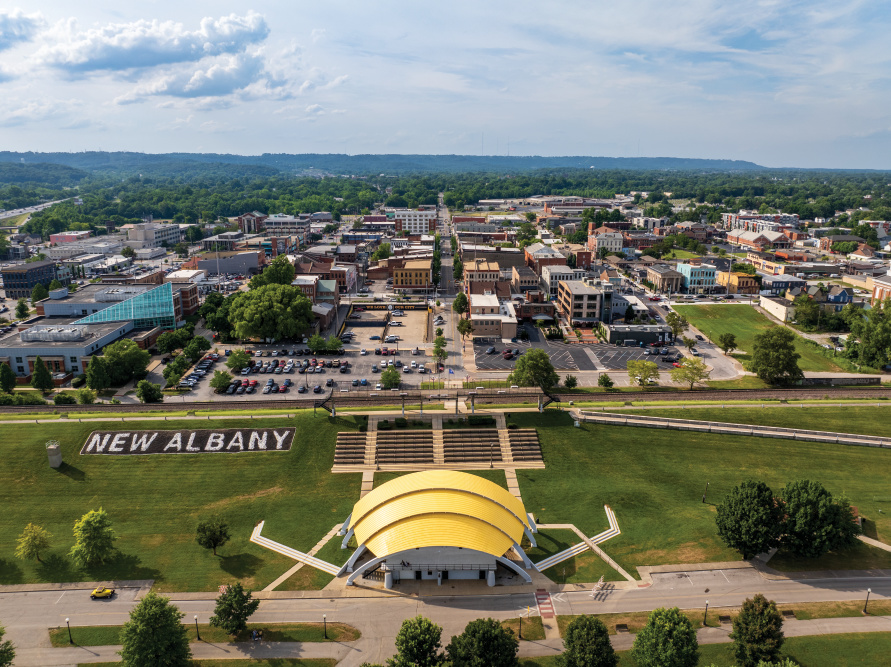
Once an antebellum riverboat capital, New Albany has transformed its historic roots into a vibrant, highly walkable destination through over a decade of sustained public investment. A dense downtown grid packs independent, locally rooted restaurants into restored 19th-century buildings, anchored by a historic year-round farmers market and free summer concerts at Bicentennial Park.
The city also serves as an open-air gallery, seamlessly blending preserved “ghost signs” and contemporary murals with the “Bright Lights in the Big N.A.” neon restoration project.
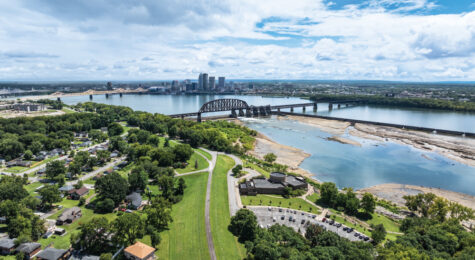
This creative energy extends right to the waterfront, which features an innovative, skateable public art installation called Flow Park, a riverfront RV park and the historic Monon South Freedom Trail – an ambitious project set to become Indiana’s longest continuous recreational trail.
“The Monon South Freedom Trail will connect generations – past, present, and future – and provide lasting benefits for our residents, businesses and visitors,” says Mayor Jeff M. Gahan.
The city’s evolution proves that prioritizing residents naturally creates a magnetic pull for outsiders. “New Albany’s appeal isn’t any single thing, it’s the accumulation,” says Claire Johnson, director of redevelopment and economic development for the City of New Albany. “It’s the result of deliberate, sustained investment in quality of life. New Albany is a great place to live, and when you do that well, visitors notice.”
Jeffersonville
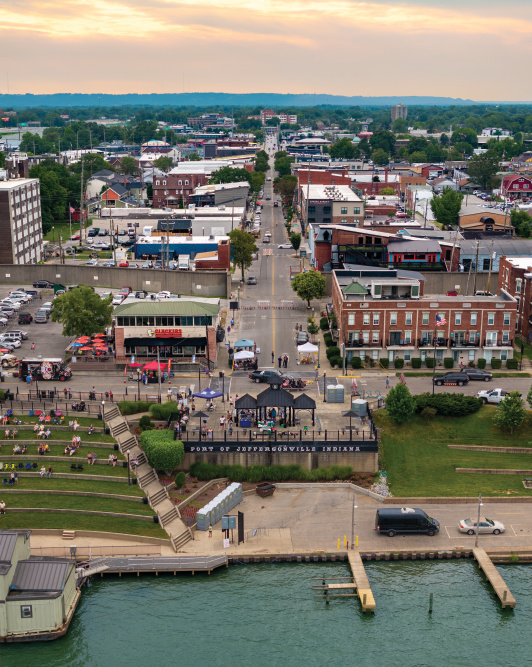
Jeffersonville’s transformation over the last decade starts with the Big Four Bridge, says Rob Waiz, the city’s economic and redevelopment director.
Named after the defunct railroad that once crossed it, the milelong pedestrian and bike path now offers some of the best river views and spectacular sunsets in the Kentuckiana region. At night, the entire iron structure lights up with a vibrant LED display along with accompanied music.
“What was once an underutilized riverfront has become one of the region’s most vibrant destinations,” Waiz says.
More than just a scenic walkway, the bridge serves as a gateway to a revived downtown. According to Waiz, it has transformed the riverfront into a bustling destination, funneling foot traffic directly into local shops and restaurants. Right at the base of the bridge ramp sits the RiverStage, a floating amphitheater repurposed from an old riverboat restaurant. Today, the RiverStage hosts the popular free “Jammin’ in Jeff” summer concert series on Friday nights, alongside a full season of community events.
This revitalization momentum carries a few blocks inland to the NoCo (North of Court Avenue) Arts and Cultural District. Here, Jeffersonville Public Art has transformed 22 acres of space into an interactive outdoor gallery. The city’s next ambitious step, Waiz adds, is repurposing a historic building into a theater and multi-purpose arts facility, creating a dedicated, year-round performance space for the community.
Get to Know Southern Indiana
Want to learn more about living and working in Southern Indiana? Check out the latest edition of Livability One Southern Indiana.
The Origin Story: River Heritage Conservancy kicks off a regional transformation with the debut of the 430-acre Origin Park in Clarksville
The River Heritage Conservancy (RHC) was formed in 2016 in Jeffersonville with a mission to transform abandoned industrial properties into exceptional public parks and green spaces. Those landscape reformations span about 7 miles along the Ohio River, stretching from Jeffersonville to Clarksville and New Albany in Southern Indiana.
Now, thanks to funding from a variety of sources, the nonprofit is tackling its first major project: developing a 430-acre tract in Clarksville called Origin Park.
“The land had largely become a site for junkyards, landfills and brownfields, so the conservancy wanted to tackle the cleanup, design and redevelopment to make it into a beautiful park attraction,” says Dennis Schnurbusch, CEO of River Heritage Conservancy.
In May 2026, RHC debuted the first phase of the development – the opening of the 14,000-square-foot The Vista at Origin Park.
“The first event at the center was a Clarksville High School prom in May 2026, and they already booked it again for their 2027 prom,” Schnurbusch says.
Another aspect of the project includes restoring 103 acres of woodlands called Buttonbush Woods, an initiative focused on removing invasive plant species while preserving natural wetlands, ponds, meadows and trails. In addition, contributing to the park’s goal of ultimate self-sufficiency will be the construction of the Wildwater Adventure Center, featuring a whitewater rapids course, ziplines, climbing walls and retail areas.
Schnurbusch says the adventure center will be modeled after the U.S. National Whitewater Center in Charlotte, North Carolina, which attracts about 1.3 million visitors annually.
“We believe attendance for Wildwater will be similar to the Charlotte facility whenever we open, based on our population within a two-and-a-half hour range,” Schnurbusch says. “Origin Park is the Conservancy’s first big project of hopefully many to come, and developing Origin Park should keep us busy for about 10 years. It’s exciting.”