
Manufacturing in Central Michigan: Reimagining the Future
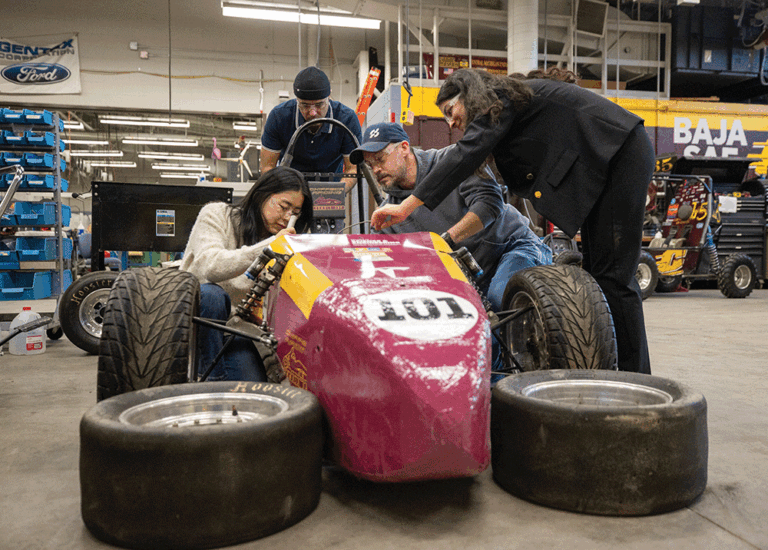
Advanced manufacturing is evolving quickly across the Great Lakes Bay and Central Michigan region, creating strong career pathways for the next generation of engineers, technicians and problem-solvers. Local companies increasingly rely on early-career professionals who bring fresh skills and a desire to solve complex challenges. Their roles go far beyond the traditional image of manufacturing, integrating advanced technology and collaborative strategy to bolster the business climate.
Manufacturing remains a cornerstone of Michigan’s economy, employing more than 600,000 workers statewide across roughly 12,000 companies, according to the Michigan Department of Labor and Economic Opportunity.
In the Great Lakes Bay and Central Michigan region alone, advanced manufacturing employers span automation, precision machining, materials science and industrial systems. For early-career professionals, that combination is opening doors to jobs that are stable, well-paying and intellectually engaging.
Architect of the Ordinary

Olivia Ostrander
Central Michigan University graduate Olivia Ostrander is one of those rising leaders whose success demonstrates that this region is attracting new talent and giving them real opportunities to grow.
While attending college, Ostrander began working full time at Powell, a St. Louis, Michigan-based firm specializing in custom-engineered chemical processing equipment.
“Powell’s flexibility was a major factor in my success,” Ostrander says. “Powell allowed me flex days to balance coursework and a full-time schedule, which made it possible to advance my education while contributing to the team.”
State data shows that registered apprenticeships in Michigan have increased steadily in recent years, reflecting growing interest in “earn while you learn” pathways that combine classroom instruction with hands-on experience. Employers across the region are responding by offering flexible schedules, mentorship and clear advancement tracks – features that resonate with early-career professionals.
In her role, Ostrander supports automation projects that help clients improve efficiency, safety and performance, giving her a front-row seat to how advanced manufacturing is changing across the region.
“My role focuses on helping clients optimize their operations through predictive maintenance strategies and proactive outreach,” she says. “By acting as a trusted adviser, I ensure they have the tools and insights to prevent costly downtime and keep their systems running efficiently.”
Ostrander has always been interested in the “why,” which makes advanced manufacturing especially interesting as a career.
“Once you work in manufacturing, you can never look at something the same again,” she says. “Our company makes equipment that produces the products people do not think twice about but need – like bleach and windshield wiper fluid. I have also always loved helping people, so being a trusted adviser to my clients allows me to help them keep their systems up and running, and I find great joy in that.”
Classroom to Career
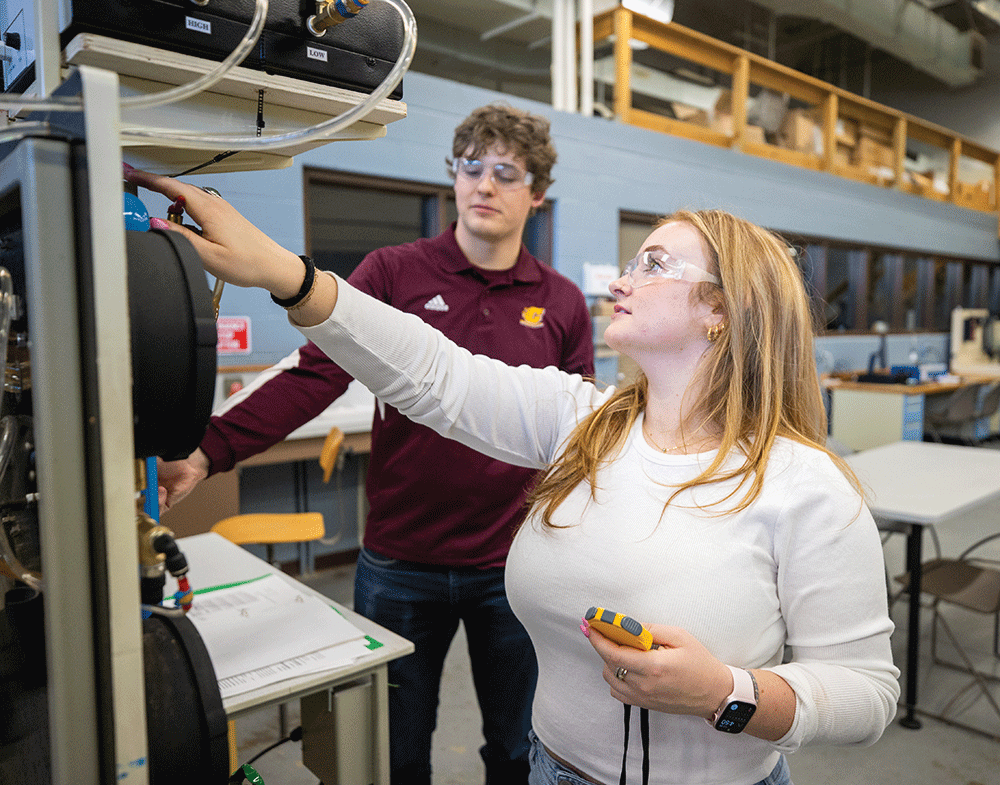
The evolution of advanced manufacturing careers is supported by a robust regional training infrastructure designed to bridge the gap between the classroom and the factory floor. Mid Michigan College’s Advanced Integrated Manufacturing pathways – spanning specialties in automation and robotics, plastics technology, machine tool, and welding – equip students with the high-tech skills today’s industry demands. In synergy with Central Michigan University’s engineering programs, these pathways create a robust talent pipeline that mirrors Ostrander’s success and fuels the regional manufacturing economy.
Ostrander’s work reflects a new era in manufacturing – one that trades traditional labor for data-driven strategy and systems thinking. It’s a shift that’s drawing in top-tier talent hungry for high-impact, high-growth careers. Her own career development has been further fueled by her involvement in regional leadership circles, which she credits with sharpening her professional edge.
“Participating in emerging-leader groups has been invaluable for building a strong professional network and connecting with rising talent across the region,” she says. “These experiences have broadened my perspective, introduced me to innovative ideas and helped me develop leadership skills that support my growth.”
Ostrander says building a career in Central Michigan is a good choice for rising professionals in manufacturing. “I enjoy the sense of community and collaboration,” she says. “The region offers a unique blend of manufacturing expertise and growth opportunities, making it an ideal environment for young professionals to learn, innovate and make a meaningful impact.”

Central Michigan a Key Advanced Manufacturing Hub
The Great Lakes Bay and Central Michigan region are emerging as a critical hub in the U.S. semiconductor and solar supply chains, with major expansions from Hemlock Semiconductor (HSC), Corning Inc. and Mersen USA driving new waves of innovation, capital investment and job growth. These developments underscore Michigan’s growing role in reshoring advanced manufacturing and strengthening domestic production of the materials essential to modern electronics, electric vehicles and solar technologies.
“These substantial capital investments into the region help magnify what those of us who live and work here already know,” says Mark Hitchcock, Bay Future economic development manager. “This is not only a great place to live, but as a region we are primed and ready to meet the demand for next-generation technologies, advanced manufacturing and more.”
HSC – the nation’s only U.S.-headquartered producer of hyper-pure polysilicon – and its parent company, Corning, have created the nation’s first Made-in-America supply chain for solar panels. Corning’s new $1.5 billion solar wafer facility, built across the street from HSC’s polysilicon plant, has hired 1,500 new employees. Polysilicon produced by HSC is delivered directly to the new Corning plant, where it is transformed into solar wafers – the key component in solar panels – making the region a significant hub fueling the nation’s energy manufacturing future.
“HSC has a 65-year legacy in the region because it offers a unique combination of skilled talent, robust infrastructure and a community deeply committed to innovation,” says AB Ghosh, Corning vice president and general manager of solar and chairman and CEO of Hemlock Semiconductor. “Corning and HSC are proud to invest here – not only in our operations but also in STEM education, workforce development and resilient communities where our employees live and thrive.”
Ghosh says Corning’s investment reflects its confidence in Central Michigan and the Great Lakes Bay region. “By co-locating wafer and polysilicon production, we eliminate critical bottlenecks and strengthen supply chain resilience,” he says. “This integration not only secures the U.S. solar supply chain but also creates 1,500 good-paying jobs and reinforces America’s leadership in advanced manufacturing.”
Meanwhile, Mersen USA is investing $81.2 million to expand operations in Bay City and Greenville, adding 115 jobs in semiconductor material production.
Mersen, a global leader in graphite and carbon insulation products used to manufacture silicon chips, is constructing four new buildings in Bay City and expanding its Greenville facility. The company chose Michigan for the expansion over a competing site in Tennessee, specifically due to the quality of materials currently being manufactured in its existing Michigan facilities.
Get to Know Great Lakes Bay and Central Michigan
Want to learn more about living and working in Saginaw, MI, and the surrounding communities? Check out the latest edition of Livability Great Lakes Bay – Central Michigan Region.