

Riverwalk, Rock Hill, SC
Riverwalk is one of Rock Hill, South Carolina’s most distinctive neighborhoods and one of the most ambitious master-planned communities in the Carolinas. Situated along the Catawba River just north of downtown Rock Hill, Riverwalk combines residential neighborhoods, outdoor recreation, trails, parks, dining, and commercial services into a community designed around active living and connection to nature.
Unlike traditional subdivisions that focus primarily on housing, Riverwalk was developed as a mixed-use community where residents can live, work, exercise, and socialize within the same area. The neighborhood’s riverfront location, extensive trail system and modern amenities have made it one of the most recognizable addresses in York County.
Today, Riverwalk attracts professionals, families, retirees, and outdoor enthusiasts who value recreation, walkability, and convenient access to both Rock Hill and the Charlotte metro area.
Overall Vibe & Lifestyle
Life in Riverwalk revolves around the outdoors.
On any given day, residents can be found jogging beside the Catawba River, cycling through the community, walking dogs along neighborhood paths, or gathering at restaurants near the riverfront. The community was intentionally planned around movement and recreation, and that focus remains one of its defining characteristics.
Riverwalk differs from a conventional suburban development in that its recreational amenities are not limited to a private pool or clubhouse. The community includes access to the Catawba River Trail, mountain bike routes, a criterium cycling course, the Rock Hill Velodrome, and the Rock Hill BMX Supercross Track.
These facilities draw visitors to the neighborhood for training, races, and community events, giving Riverwalk a more energetic atmosphere than many traditional subdivisions. At the same time, residential streets remain set apart from much of the public activity, allowing the neighborhood to retain a relaxed riverfront character.
Young professionals appreciate the newer housing and regional access. Families are drawn to the trails, green space, and recreational opportunities. Retirees and remote workers often value the ability to walk, exercise, and spend time outdoors close to home.
The overall atmosphere feels active, contemporary, and community-oriented.
Safety & Walkability
Riverwalk is one of Rock Hill’s more walkable suburban communities.
Sidewalks and multi-use paths connect many of the residential, recreational, and commercial areas. Depending on where they live, residents may be able to walk or bike to restaurants, fitness facilities, trail access points and riverfront gathering places.
The Catawba River Trail serves as the backbone of the community’s public trail network. The paved trail follows the river between Riverwalk and River Park, giving walkers, runners, and cyclists a longer route through wooded and waterfront scenery.
Walkability varies within the development. Homes and apartments closest to the River District generally offer the easiest pedestrian access to dining and services. At the same time, residents in farther-flung residential sections may still need to drive for daily errands.
Riverwalk Parkway and the roads leading toward Cherry Road and Celanese Road carry more traffic than the internal residential streets. Buyers who prioritize walking should evaluate the specific route between a prospective home and the destinations they expect to use regularly.
Natural & Built Environment
Riverwalk’s greatest asset is its setting along the Catawba River.
The community was designed to make the river and surrounding landscape visible parts of daily life. Wooded areas, river views, green space, and trails soften the appearance of the newer residential and commercial development.
The Catawba River Trail connects Riverwalk with River Park, a large public park that includes paved paths, boardwalks and natural-surface trails through wooded land along the river. The connection allows residents to extend a neighborhood walk or bike ride into a larger recreation area without relying entirely on a car.
Riverwalk also provides public access for canoes and kayaks. Paddlers can enter the Catawba near the development and travel downstream toward River Park, passing wooded banks, shallow shoals and historic railroad structures.
The built environment is more structured. Homes, apartments, commercial buildings, and public recreation facilities were developed as parts of one broader plan. That coordination gives Riverwalk a stronger visual identity than an area assembled from unrelated subdivisions and shopping centers.
The result is a neighborhood that feels modern without being separated from the landscape that defines it.
Design & Architecture
Architecture throughout Riverwalk reflects the community’s master-planned origins.
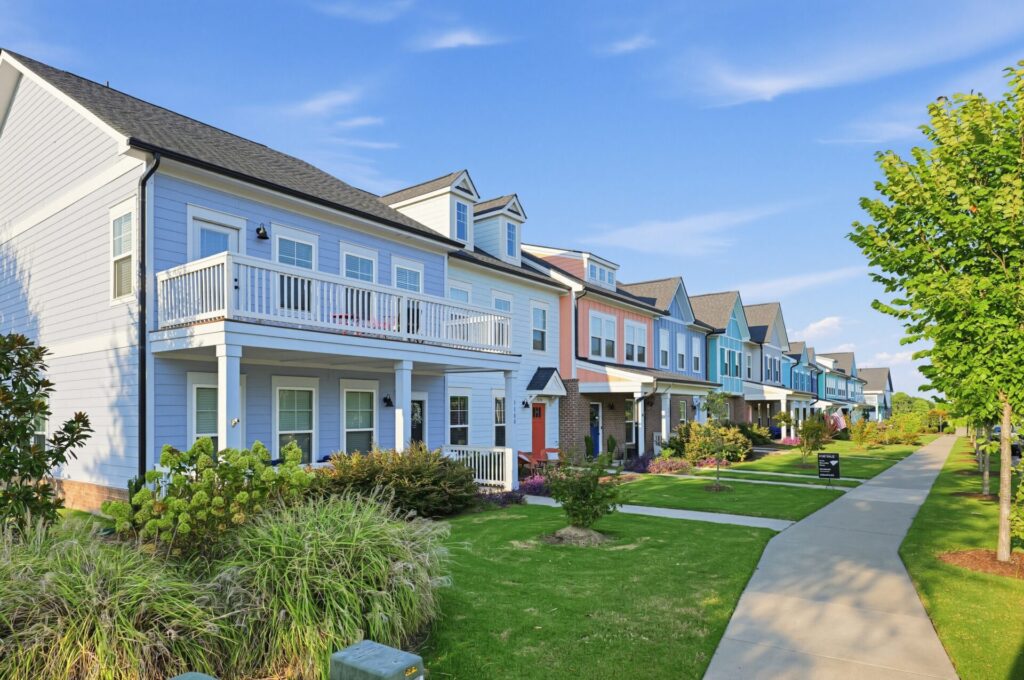
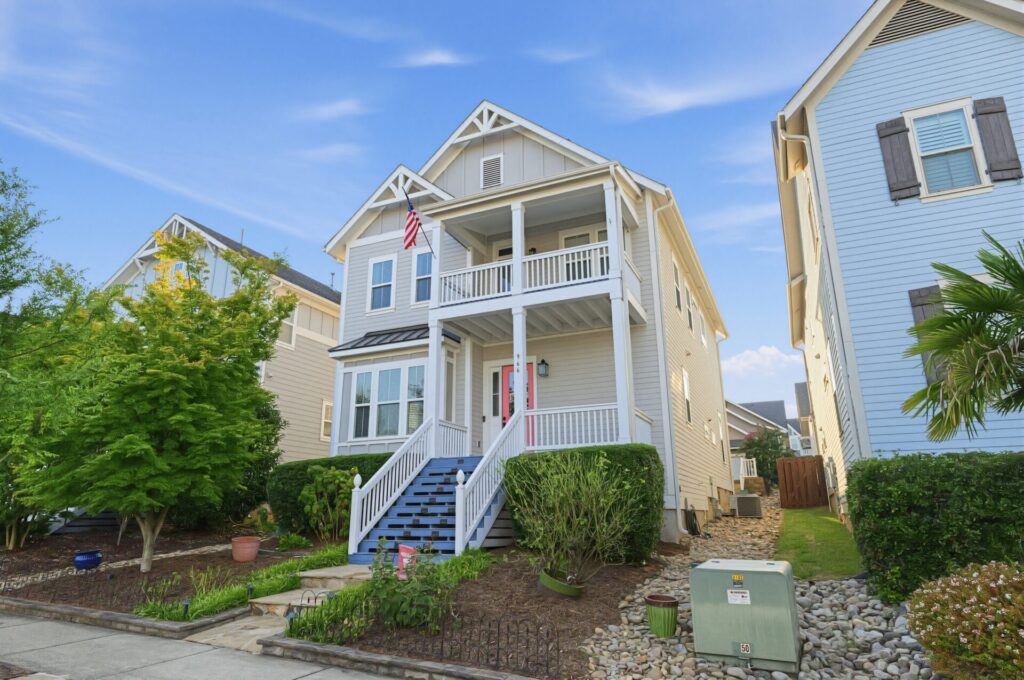
Housing includes detached single-family homes, townhomes, and apartments. Craftsman, traditional, and Lowcountry influences appear throughout the neighborhood, often with front porches, sidewalks, rear garages, and relatively close setbacks intended to create a more connected streetscape.
Newer homes typically feature open floor plans, large kitchens, flexible living spaces, and contemporary finishes. Townhomes provide lower-maintenance options, while detached homes offer additional privacy, yard space and room for families.
The River District introduces a more urban residential style. Apartment buildings place residents closer to restaurants, trails, and riverfront activities. Individual apartment communities may also offer private pools, fitness centers, lounges, and workspaces.
Those private amenities should not be confused with Riverwalk’s public facilities. The trails, river access, velodrome and BMX track are community and regional destinations, while pools, clubhouses and other shared residential features vary by apartment complex or homeowner association.
Unlike some master-planned communities that rely on a single home style, Riverwalk offers enough variation in housing types and scales to create visual interest while maintaining a cohesive identity.
Housing at a Glance
| Metric | Description |
|---|---|
| Housing types | Single-family homes, townhomes, and apartments |
| Common architectural styles | Craftsman, traditional, and Lowcountry-inspired designs |
| Typical features | Open floor plans, front porches, modern kitchens, garages, and access to sidewalks or trails |
| Public amenities | River trails, paddlesport access, cycling facilities, green space, and recreation areas |
| Private amenities | Vary by development and may include pools, fitness centers, lounges, and shared outdoor spaces |
| Community character | Modern, mixed-use, active, and river-oriented |
Real Estate Snapshot
Riverwalk has become one of Rock Hill’s most recognizable residential markets.
Demand is driven by the neighborhood’s combination of newer housing, riverfront recreation and convenient regional access. Buyers frequently compare Riverwalk with more conventional suburban developments and choose it for the lifestyle created by its trails, cycling facilities, and mixed-use plan.
Housing options include resale homes, new construction, townhomes, and rental apartments. Properties closer to the River District may provide easier walking access to restaurants and services. At the same time, homes farther into the residential sections may offer quieter streets and greater separation from public activity.
Prices generally reflect the neighborhood’s newer construction and amenity-rich setting. However, costs vary according to housing type, size, location, and the private amenities associated with a particular development.
Buyers should review the homeowners’ association structure carefully. Fees, architectural standards, landscaping responsibilities, and access to private amenities may differ between detached homes, townhomes, and individual sections of Riverwalk.
Because the community continues to develop, buyers should also consider how planned roads, vacant parcels, and future commercial construction could affect a particular property.
Amenities & Local Conveniences
Riverwalk’s amenities are what most clearly distinguish it from Rock Hill’s traditional residential neighborhoods.
The Catawba River Trail provides a paved route along the river and connects the community with River Park. Residents can use the trail for walking, running, and cycling, while nearby natural-surface paths and mountain-bike routes offer a less-developed outdoor experience.
Public river access allows residents and visitors to launch canoes and kayaks. This makes paddling a practical neighborhood activity rather than something that requires a longer drive to Lake Wylie or another regional park.
Cycling is especially important to Riverwalk’s identity. The Rock Hill Velodrome is an outdoor cycling track used for training, recreational riding, and competitions. Riders must complete the required certification before using the track, but spectators can attend races and other events.
The Rock Hill BMX Supercross Track hosts beginner programs, local races, and major competitions. The facility has helped establish Rock Hill as a national destination for BMX and cycling sports.
Riverwalk’s criterium course provides another paved cycling environment, while the surrounding mountain bike trails offer wooded routes with different levels of difficulty. Together, these facilities make cycling more than a marketing theme. It is a visible part of daily life in the community.
The Riverwalk YMCA provides indoor fitness, classes, and community programming. Charlotte Running Company also operates in the River District, serving runners and walkers who use the nearby trail system.
Dining and social life are concentrated around the riverfront commercial area. The Pump House is Riverwalk’s best-known restaurant and occupies a converted industrial building overlooking the Catawba River. Its patios and river views make it a destination for residents and visitors from across the region.
Other nearby options include Tony’s Cantina Mexican Grill, Inside Scoop Creamery and Grapevine Wine Shop and Wine Bar. These businesses give residents places to meet for dinner, dessert, or drinks without traveling into downtown Rock Hill.
Riverwalk also includes dental, personal care, and professional services. Grocery stores and larger shopping centers remain a short drive away along Cherry Road, Celanese Road, and other nearby commercial corridors.
Health care is accessible, although Piedmont Medical Center is not located inside Riverwalk. The hospital’s main Rock Hill campus is on South Herlong Avenue, and additional primary care, urgent care and specialty offices are available throughout the city.
For many residents, Riverwalk’s greatest advantage is the way it combines recreation, dining and residential life. A person can walk along the river, use a city-operated sports facility, and have dinner overlooking the water without leaving the broader community.
Schools & Education
Rock Hill Schools serve Riverwalk, but assignments depend on the exact property address.
Independence Elementary School, Sullivan Middle School, and Rock Hill High School commonly serve addresses in and around Riverwalk. Families should verify current attendance boundaries directly with the district before making a housing decision.
Rock Hill Schools offers Advanced Placement, honors, dual-enrollment, arts, and career and technical education. Students may also apply for specialized district programs located outside their assigned neighborhood school.
Riverwalk Academy is a public charter school in Rock Hill, but it is not part of the Riverwalk residential development despite sharing the name. The school maintains its own application, enrollment, and transportation procedures.
Higher education options are close by. Winthrop University is located near downtown Rock Hill, while York Technical College offers associate degrees, technical credentials, university-transfer courses, and workforce training.
Commuting & Location
Riverwalk combines a scenic setting with convenient regional access.
| Destination | Approximate Drive Time |
|---|---|
| Downtown Rock Hill | About 10 minutes |
| River Park | About 5 to 10 minutes by car or accessible by trail |
| Winthrop University | About 10 to 15 minutes |
| Fort Mill | About 15 to 20 minutes |
| Uptown Charlotte | About 30 to 45 minutes |
| Charlotte Douglas International Airport | About 35 to 45 minutes |
| Lake Wylie | About 20 minutes |
Drive times vary depending on the starting address, time of day, and traffic conditions.
Riverwalk Parkway connects with Cherry Road and Celanese Road, providing access to Interstate 77 and the rest of Rock Hill. The location can work well for residents who commute toward Charlotte, although congestion on I-77 can add substantial time during peak periods.
Residents who work in Rock Hill can reach downtown, Winthrop University, health care facilities, and major commercial districts without relying on the interstate.
Riverwalk Neighborhood Map
Quirks & Perks
Few neighborhoods in the Charlotte region combine residential living with this concentration of public recreation facilities.
A resident can walk beside the Catawba River, watch track cycling at the velodrome, attend a BMX event, use the criterium course, launch a kayak, and have dinner overlooking the water without leaving Riverwalk.
The neighborhood also draws people who do not live there. Race participants, trail users, diners, and paddlers add energy to the area, but major events can also increase traffic and parking demand near the public facilities.
Riverwalk’s mixed-use plan is another perk. Restaurants, apartments, offices, fitness facilities, and houses are located within the same development rather than being separated into distant residential and commercial zones.
The trade-off is that the community is still evolving. Active construction, changing retail tenants, and future development may continue to alter how individual sections look and function.
Neighborhood Logistics
Riverwalk operates within the City of Rock Hill, which provides municipal police, fire protection, sanitation, utilities, and public works services.
Most ownership communities have homeowner association rules governing architecture, landscaping, and common areas. The specific association, fees, and included amenities depend on the property type and section of Riverwalk.
Residents should not assume that every advertised amenity is available to every household. City trails, river access, the velodrome, BMX track, and other public facilities are open beyond the residential community. Pools, fitness rooms, lounges, and clubhouses may belong to a particular apartment complex or homeowner association.
Parking is generally available at homes, apartment buildings, and commercial areas. Public trailheads and sports facilities provide designated visitor parking, although events can increase demand.
For buyers seeking a neighborhood that prioritizes active living and access to nature, Riverwalk remains one of the most compelling options in the Charlotte metro area.
Explore Rock Hill Neighborhoods
Note on imagery: Images marked “AI Generated” are visuals to illustrate the neighborhood homes, atmosphere and architectural style. To protect homeowner privacy, these images are artistic representations and do not depict specific existing properties.