

Research Institutions Pioneer Solutions for the Future in Greater Chattanooga

Research and development efforts at colleges and universities play a crucial role in economic and workforce development.
In Greater Chattanooga, these institutions drive innovation, attract investment and often lead to the development of new businesses. The University of Tennessee at Chattanooga (UTC), for example, is close to achieving the prestigious R2 university status, and its groundbreaking projects in areas such as quantum computing are gaining momentum and recognition.
Meanwhile, the University of Tennessee Health Science Center (UTHSC) College of Medicine – Chattanooga is making significant strides in medical research, addressing some of the most pressing health care challenges in the region and around the globe.
The Road to R2
Robert Dooley, dean of the Gary W. Rollins College of Business, says moving toward R2 designation is an important milestone for the university. R2 universities are those with high research activity; between fiscal years 2022 and 2024, UTC averaged a total of $13.2 million in research spending.
“This kind of designation isn’t just about prestige; it also brings tangible benefits,” Dooley says. “It helps us attract talented students and faculty, and it sends a strong signal to businesses and industry partners that UTC has the research capacity and the workforce development pipeline to meet their needs. It positions us as a key driver of innovation and economic growth in the region.”
Small Wonders
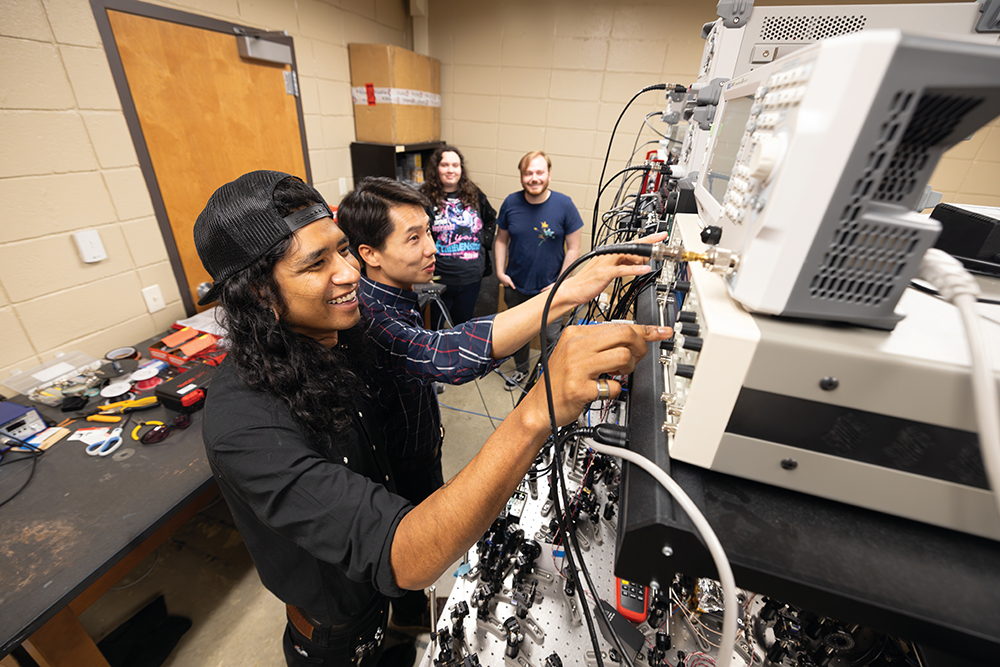
The university is quickly becoming a leader in quantum research and development. Recently, UTC established the Quantum Center connected to EPB Quantum Network powered by Qubitekk – one of the first commercially available quantum networks in the country. The university also partners with Oak Ridge National Laboratory (ORNL) to advance research in areas such as quantum networking, distributed quantum computing and quantum algorithm development.
“As founding members of the Chattanooga Quantum Collaborative, we are working together to build regional capacity in Quantum Information Science and Engineering (QISE),” Dooley says. “Our goal is to position UTC as a national leader in quantum networking, sensing and computing. We’re developing research capacity in these areas while strengthening key partnerships with EPB and ORNL, other national labs, and with academic and industry collaborators across the country.”
He says the Quantum Center’s focus includes demonstrating networked quantum computing over substantial distances, exploring how quantum computing can be applied to artificial intelligence applications and identifying real-world use cases – from quantum sensing in smart grid systems to applications in smart cities and advanced mobility.
“Chattanooga’s transformation over the past few decades has been remarkable, from being labeled the dirtiest city in America in 1969, to becoming the first Gig City and now home to the nation’s first commercial quantum network. This community has become a national model for urban renewal and smart city innovation,” Dooley says.
Healthy Innovation
A major player in that transformation is the UTHSC College of Medicine-Chattanooga, which is actively involved in researching new drugs and therapies for chronic diseases such as diabetes and hypertension. By collaborating with local and national hospitals and health care providers, the college ensures that its findings are translated into practical applications that benefit the community.
“We work with drug companies and device companies to conduct clinical trials to determine the effectiveness of new drugs and devices. The data we collect is used to help these companies obtain FDA approval,” says Giuseppe Pizzorno, associate dean for research for UTHSC College of Medicine – Chattanooga and chief research officer for Erlanger Health System. “But we are also exposing the medical students to new treatments and discoveries for various diseases. This inevitably improves patient care and outcomes once they become providers, whether in Chattanooga or elsewhere in the country.”
One of the more impactful projects was the study of the effectiveness of a new AI system for detecting polyps during colonoscopies. Pizzorno says that while colonoscopies are still the best option for detecting polyps, some lesions can be missed during the process. His researchers, as part of a larger international team, hope this new software will help remedy that issue.
“We now have this device that helps guide the physician during the colonoscopy process and it is actually finding more lesions,” he says.
Pizzorno says the Chattanooga region’s status as a technology hub gives the college an advantage when attracting students and researchers.
“We’re able to attract the best residents, the best physicians and the best clinical investigators because they know that we have an infrastructure that can support their research,” he says.
Find Success in Greater Chattanooga
Learn more about the region’s business and economic opportunities at livability.com/chattanooga-region.