

Homestead at Carter’s Station, Columbia, TN: Newer. Residential. Convenient.
Homestead at Carter’s Station is a newer residential community in northern Columbia, Tennessee, near the Spring Hill boundary. Developed primarily by Centex Homes, the neighborhood is part of the larger Carter’s Station growth area, where several separately branded subdivisions have been developed along and around the Cleburne Road corridor.
Homestead itself was developed in multiple sections and phases rather than as a single small subdivision. Columbia planning records identify numerous phases of Homestead at Carter’s Station, with residential streets including Hidden Creek Way, Holiday Lane, Timewinder Way, and Tonklin Court. Construction began in the late 2010s and continued into the 2020s, and the original Centex new-home community has since sold out, shifting Homestead from an active-builder community to a conventional resale neighborhood.
Overall Vibe & Lifestyle
Daily life in Homestead at Carter’s Station reflects a modern suburban environment. Detached houses, private yards, attached garages, and residential streets dominate the neighborhood, with most shopping, dining, and services reached by car.
The community is newer than Columbia’s established central neighborhoods but mature enough that much of the original construction has ended. Its northern location gives residents practical access to both Columbia and Spring Hill, making the neighborhood useful for households whose routines extend beyond downtown Columbia — a setting more closely connected to Maury County’s northward suburban growth than to Columbia’s historic core.
Safety & Walkability
Homestead is primarily a car-dependent neighborhood, although its internal street design supports recreational walking. City planning documents for later sections specify sidewalks separated from the roadway by grass strips, creating a more pedestrian-oriented internal environment than many older rural roads around Columbia.
Residents can walk around the neighborhood, but everyday destinations such as restaurants, grocery stores, and major retail are outside the subdivision, so a vehicle remains necessary for most errands. The surrounding Carter’s Station area is similarly suburban, with residential communities connected by larger roads rather than a walkable commercial center.
Natural & Built Environment
Homestead combines planned suburban development with the rolling landscape of northern Maury County. The community was marketed around hilltop views, tree-lined homesites, and relatively generous residential lots, although lot size varies considerably by section. Later phases include cul-de-sacs and properties backing toward undeveloped or tree-lined areas.
Individual documented properties can be more compact — a 2026 sale on Holiday Lane occupied about 0.15 acres — illustrating why Homestead should not be characterized uniformly as a large-lot neighborhood. Landscaping has had several years to establish, so while Homestead lacks the mature canopy of mid-20th-century Columbia neighborhoods, it increasingly feels like an established residential community.
Design & Architecture
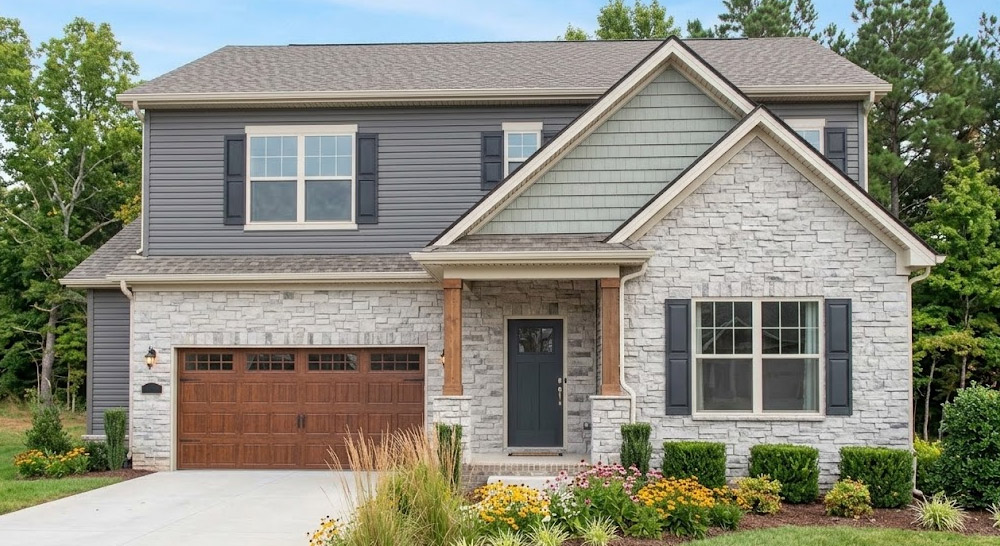
Homes are contemporary suburban designs, primarily from the late 2010s through the early 2020s. Centex offered numerous floor plans from smaller single-story houses to larger two-story homes with four or five bedrooms; documented homes range from about 1,500 square feet to well over 3,000.
Open-concept interiors are common, with large kitchen islands, combined kitchen and gathering areas, flex rooms, upstairs lofts, walk-in closets, and first- or second-floor primary suites depending on the plan. Attached two-car garages are prevalent, and exteriors follow contemporary traditional styling with brick, stone, or masonry accents and siding. Because the neighborhood spans multiple phases and plans, the streetscape offers more variation than a small subdivision.
Housing at a Glance
Homestead at Carter’s Station consists primarily of newer detached single-family homes built from the late 2010s into the 2020s.
| Type | Primarily detached single-family homes. |
| Size & Layout | Approximately 1,500 to 3,700+ square feet across documented properties. |
| Bedrooms & Baths | Generally 2–5 bedrooms and 2–4 bathrooms. |
| Interior Features | Open-concept living, kitchen islands, flex rooms, lofts, and walk-in closets depending on plan. |
| Exterior Features | Attached garages, private yards, contemporary traditional facades, and patios or covered outdoor spaces. |
| Development Period | Primarily late 2010s through early-to-mid 2020s. |
Real Estate Snapshot
Real estate here is driven by relatively recent construction, established infrastructure, and its position within the larger Carter’s Station development. With Centex’s original buildout complete, Homestead is transitioning into a resale market where availability depends on existing homeowners deciding to sell.
That distinction matters because new construction remains available elsewhere in the broader Carter’s Station area — properties marketed simply as “Carter’s Station” may belong to Homestead, Highlands, Independence, Summit, Ridge, or another separately developed community. Within Homestead, pricing is shaped by floor plan, lot location, condition, and improvements; buyers should confirm the specific community and governing association for each listing.
| Market Demand | Established newer-home resale market in northern Columbia. |
| Inventory | Primarily resale properties following completion of the original Centex buildout. |
| Buyer Profile | Buyers seeking a relatively recent home with modern layouts and access to both Columbia and Spring Hill. |
| Pricing Context | Varies based on floor plan, size, lot, upgrades, and condition. |
| Investment Pattern | Increasingly driven by the resale market rather than builder-controlled new-home pricing. |
Amenities & Local Conveniences
Homestead’s location matters more to daily convenience than an extensive set of private amenities. The surrounding Carter’s Station area is primarily residential, so residents travel toward Columbia or Spring Hill for shopping, dining, and entertainment. Spring Hill’s commercial corridors provide groceries, restaurants, and larger retailers to the north, while downtown Columbia offers a more locally oriented environment to the south.
In downtown Columbia, Muletown Coffee Roasters operates on the Public Square and has been roasting and brewing coffee locally since 2013, alongside independent restaurants, boutiques, and community events. For larger outdoor recreation, Maury County Park encompasses about 242 acres with walking areas, playgrounds, sports facilities, pavilions, a dog park, and equestrian facilities — though those destinations are generally reached by car rather than on foot.
Schools & Education
School assignments in the Carter’s Station area deserve particular attention because the community sits near the Columbia–Spring Hill growth corridor, where attendance boundaries can change as northern Maury County develops. Older marketing emphasized access to Spring Hill-area schools, but families should not rely on historical builder advertising.
Maury County Public Schools should be used to verify the elementary, middle, and high school assigned to the exact property being considered. This address-specific approach matters because “Carter’s Station” encompasses several distinct subdivisions across a larger development area rather than a single small neighborhood.
Commuting & Location
Homestead’s northern Columbia location is one of its primary advantages. The neighborhood sits closer to Spring Hill than communities around downtown Columbia and provides access to Saturn Parkway and Interstate 65 for regional commuting.
| Destination | Approximate Drive Time |
| Spring Hill | 10–15 minutes |
| Downtown Columbia | 15–20 minutes |
| Franklin | 25–35 minutes |
| Nashville | 40–50 minutes |
Drive times vary with traffic, starting point, and destination. For residents commuting north, Homestead offers a Columbia address and Maury County location without a trip through downtown before heading toward Spring Hill, Franklin, or Nashville.
Homestead at Carter’s Station Neighborhood Map
Quirks & Perks
Homestead’s biggest quirk is its name: “Carter’s Station” sounds like a single subdivision but is better understood as a larger development area containing several separately branded communities — city records separately identify Homestead, Independence, Summit, and Ridge at Carter’s Station, among others. Two houses advertised as being in Carter’s Station may have different builders, plans, amenities, association rules, and price ranges.
Homestead’s buildout status is an advantage for some buyers — relatively recent construction with less ongoing building activity than an actively developing subdivision. Some sections offer wooded edges, cul-de-sac locations, and elevated terrain, and the housing range is notable, spanning homes around 1,500 square feet to properties exceeding 3,000.
Neighborhood Logistics
Homestead was developed as a planned community in multiple legally recorded sections and phases, including Sections 2, 5, and 6. Homeowners association dues apply to at least portions of the community — a March 2026 sale in Homestead Section 5 Phase 2B reported monthly HOA dues of $30 — so buyers should verify the current assessment, governing documents, and restrictions for the specific property.
The original Centex new-construction offering is now sold out, so buyers should distinguish Homestead resale listings from newly built homes marketed in other Carter’s Station communities. That transition is one of Homestead’s strongest practical traits: housing recent enough to meet modern floor plans and building standards, with much of the disruption of initial subdivision construction already passed. It occupies a useful middle ground — newer than the established neighborhoods around central Columbia, more settled than communities still in initial buildout, and oriented toward the growing Columbia–Spring Hill corridor.
Explore Columbia Neighborhoods
Note on imagery: Images marked “AI Generated” are visuals to illustrate the neighborhood homes, atmosphere and architectural style. To protect homeowner privacy, these images are artistic representations and do not depict specific existing properties.