

Charlotte Corridor, Nashville: Evolving. Connected. Casual.
The Charlotte Corridor refers to the dynamic stretch of Charlotte Avenue (U.S. 70) extending west from downtown Nashville through neighborhoods including Sylvan Park, The Nations, and into West Nashville. Historically a commercial and industrial artery, the corridor has transitioned over the past two decades into a mixed-use spine lined with restaurants, breweries, fitness studios, service businesses, and mid-rise residential development. Its identity is less about a single centralized neighborhood and more about a continuous urban corridor linking established residential pockets with major adaptive reuse projects like Marathon Village and Sylvan Supply.
Overall Vibe & Lifestyle
Life along the Charlotte Corridor centers on Charlotte Avenue itself, which functions as both a commuter route and a commercial strip. The vibe is practical yet energetic, defined by a mix of long-standing staples and trendy newcomers. On a typical Saturday, residents might grab lunch at Hattie B’s Hot Chicken or 51st Deli before heading to a local brewery.
Because the corridor spans several distinct areas, the lifestyle shifts as you move west. Near downtown, the energy is industrial and entertainment-focused, anchored by venues like Marathon Music Works. Further west, near M.L. Rose Craft Beer & Burgers — Sylvan Park, the atmosphere becomes more neighborhood-centric, where families and young professionals gather on patios. The area supports a “come as you are” mentality, shaped by repeat-use restaurants and everyday retail rather than exclusive luxury experiences.
Safety & Walkability
Charlotte Avenue is a major arterial roadway and carries significant vehicle traffic. Sidewalk infrastructure is present along much of the corridor, though pedestrian comfort varies by block depending on traffic speed, lighting, and frontage design. Walkability is strongest within the adaptive reuse hubs and adjacent residential neighborhoods, where smaller streets create a calmer pedestrian environment.
Public safety data and incident reports are maintained by the Metro Nashville Police Department and can be reviewed through official city dashboards. As with any major corridor, conditions can vary block by block and should be evaluated at the property level.
Natural & Built Environment
Despite being a major thoroughfare, the Charlotte Corridor is anchored by significant green space. Richland Park serves as a central gathering spot for the western end of the corridor, hosting a library and a weekly farmers market. Just beyond, McCabe Park offers extensive recreational options, including a golf course and community center.
Connecting these spaces is the Richland Creek Greenway, a paved multi-use trail system that loops through the area, providing a crucial escape from the noise of the avenue. Near the eastern edge, the massive Centennial Park and The Parthenon sit just blocks off the corridor, offering easy access to the city’s premier urban park. The built environment is a stark mix of eras: gritty industrial warehouses converted into creative offices sit just down the street from mid-century commercial buildings and sleek, modern mixed-use apartments.
Design & Architecture
Architectural character shifts significantly along the corridor. The eastern section is defined by heavy industrial adaptive reuse, best exemplified by the brick warehouses of Marathon Village. Moving west, the corridor features contemporary infill developments like L&L Market, which repurposed an old hosiery mill into a high-end retail and dining destination.
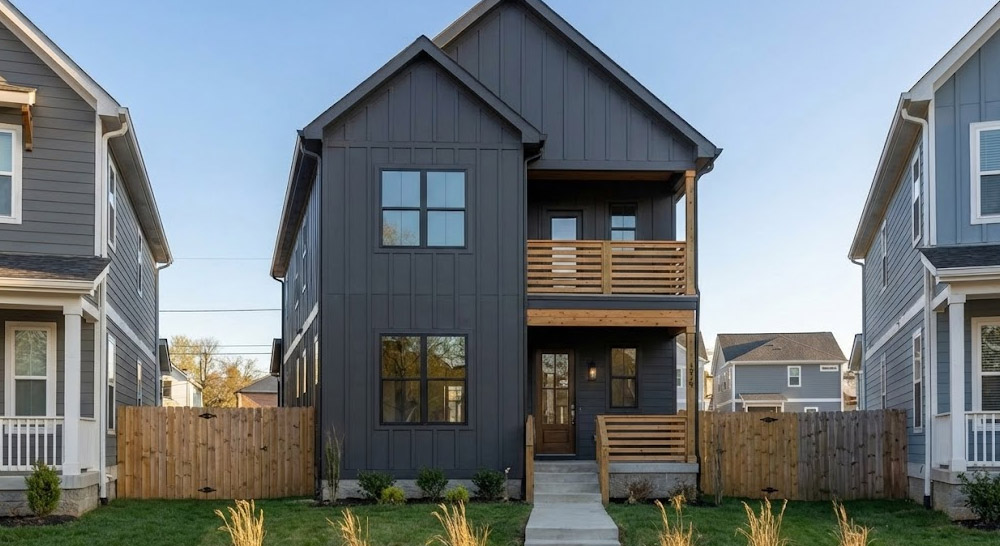
Residential pockets just off the main road, particularly in Sylvan Park, feature early-20th-century cottages and bungalows. Meanwhile, The Nations offers a blend of original modest homes and tall, narrow contemporary infill construction (“tall-skinnies”). Unlike master-planned communities, design consistency varies by block, reflecting incremental redevelopment layered onto an older transportation spine.
Housing at a Glance
Housing along the Charlotte Corridor varies depending on distance from the avenue and neighborhood context. Single-family homes dominate the interior blocks of adjacent neighborhoods, while townhomes and mid-rise apartment buildings are more common directly along Charlotte Avenue. Property age ranges from early 1900s cottages to recently completed mixed-use developments, and lot sizes generally reflect traditional urban planning patterns.
The area features a mix of single-family cottages, modern “tall-skinny” infill, townhomes, and mid-rise apartments along the main avenue. Home ages range widely, with historic early-1900s homes in Sylvan Park, 1950s ranches in West Nashville, and contemporary construction underway or recently completed. Styles include Craftsman bungalows, industrial lofts, contemporary townhomes, and modern mixed-use residential, with historic homes often modest in size and new infill maximizing vertical space. Expect hardwood floors and front porches in original homes and features like rooftop decks and open floor plans in new construction.
| Metric | Description |
|---|---|
| Type | Mix of older single-family pockets, small multifamily, and newer apartment/mixed-use concentrated along Charlotte Avenue. |
| Age | Older housing stock in adjacent neighborhoods, with ongoing infill and redevelopment activity along the corridor. |
| Styles | Varies by pocket; corridor development includes contemporary mixed-use and newer multifamily. |
| Size & Layout | Varies substantially by segment and distance from Charlotte Avenue. |
| Lot Sizes | Typically smaller urban lots near the corridor; more variation in adjacent residential pockets. |
Real Estate Snapshot
The Charlotte Corridor real estate market is shaped by its proximity to downtown Nashville and West End employment centers. Strong demand comes from professionals and families seeking urban convenience without downtown density. Inventory is moderate with new construction providing additional supply, but homes with historic character remain competitive. Young professionals, health care workers, and investors make up a large share of buyers. Premium pricing is common, especially for walkable areas close to hotspots like Sylvan Supply and L&L Market. The area is characterized by heavy investment in renovation and infill construction, with commercial growth also driving residential value.
| Metric | Summary |
| Market Demand | Strong due to connectivity and commercial growth. |
| Inventory | Moderate; increased by ongoing infill and corridor development. |
| Buyer Profile | Professionals, families, and investors seeking central access. |
| Pricing Context | Varies widely by proximity to the corridor and housing type. |
| Investment Pattern | Blend of owner-occupancy, long-term rentals, and redevelopment. |
Amenities & Local Conveniences
Amenities along the Charlotte Corridor are linear rather than centralized. L&L Market functions as a commercial hub, housing a collection of boutiques, food vendors, and fitness options under one roof. For fitness enthusiasts, Climb Nashville offers bouldering and rock climbing right on the corridor. Health care access is robust with TriStar Centennial Medical Center at the eastern edge. For social hours or dining out, options abound — Southern Grist and Fat Bottom Brewing are just two of the standout local beverage destinations. The corridor serves as a high-utility spine where you can find most daily needs, from grocery shopping to medical appointments, without leaving the area.
Schools & Education
The Charlotte Corridor is served by Metro Nashville Public Schools (MNPS), with assignments varying along this extended corridor from the Hillsboro Cluster to the James Lawson High School Cluster. Specific school zoning varies by address and can be verified using MNPS district maps.
The corridor’s location along one of Nashville’s primary westbound routes also places residents within commuting distance of a mix of private schools — St. Ann Catholic School is a local landmark — and higher education institution across the broader metro area, including Tennessee College of Applied Technology Nashville and Lipscomb University.
Commuting & Location
Charlotte Avenue (U.S. 70) is a principal connector and provides direct, efficient access into downtown Nashville. Interstate 40 (I-40) is very close, with multiple ramps and access points for commuters. The Nations neighborhood is just minutes away, and you’re also close to Midtown/Vanderbilt and Green Hills, making the corridor a prime location for both work and play. Depending on destination and time of day, commute times vary but generally remain convenient.
| Destination | Approximate Drive Time* |
|---|---|
| Downtown Nashville / CBD | 8-20 min |
| Nashville International Airport (BNA) | 15-30 min |
| Vanderbilt / West End | 5-15 min |
Quirks & Perks
A defining quirk of the Charlotte Corridor is its blend of old and new, with classics such as Bobbie’s Dairy Dip and Wendell Smith’s serving the neighborhood for decades, alongside trendy new establishments like Roze Pony and Streetcar Taps & Garden. Thistle Farms, a mission-driven business supporting women survivors, operates a popular café and shop. Several East Nashville favorites have set up outposts on the West side, including 5 Points Pizza and the soon-to-open Two Ten Jack. This unique collection of hyperlocal businesses, many with a strong community or craft focus, gives the area an authentic, lived-in feel that stands out even as the city grows.
Explore Nashville Neighborhoods
Note on imagery: Images marked “AI Generated” are visuals to illustrate the neighborhood homes, atmosphere and architectural style. To protect homeowner privacy, these images are artistic representations and do not depict specific existing properties.