

East Nashville, TN: Creative, Historic and Community-Centered
East Nashville sits just across the Cumberland River from downtown Nashville and is one of the city’s most personality-driven areas. Life here blends the convenience of proximity to downtown with the feeling of being rooted in distinct neighborhoods like Five Points or Lockeland Springs. Longtime residents and newer transplants alike often note that the area feels more informal and community-scaled than other parts of the city, with older homes, front porches, and locally owned businesses shaping the rhythm of the area. East Nashville is a place where day-to-day life still happens close to home rather than around large commercial centers or planned developments.
Because East Nashville developed as a collection of older residential pockets rather than a single planned community, each neighborhood has a unique personality. Factors like housing style, walkability, proximity to parks, and access to restaurants and nightlife differ block by block.
Overall Vibe & Lifestyle
The vibe in East Nashville is informal, lived-in, and fiercely independent. The lifestyle revolves around local businesses and community spaces. A typical weekend might involve grabbing coffee at Ugly Mugs, browsing for vinyl at Grimey’s New & Preloved Music, and catching a show at The Basement East. There’s less emphasis on curated experiences and more on authentic, neighborhood-level interaction.
The area functions through a network of small commercial nodes — like the bustling Five Points intersection or the quieter Riverside Village — rather than a single focal point. This creates distinct experiences in each neighborhood. The pace is generally active without feeling rushed, supporting a culture where neighbors connect at local parks, farmers’ markets, and beloved restaurants like Mas Tacos Por Favor.
Safety & Walkability
East Nashville is not a gated community, and its streets function as open, mixed-use corridors. Walkability is strongest in areas closer to established commercial hubs like Five Points and the shops along Fatherland Street, where sidewalks are more common and daily errands can often be completed on foot.
In other parts of East Nashville, sidewalks may be inconsistent or absent, and residents rely more on cars. Biking is very common, particularly along designated greenways like the Shelby Bottoms Greenway and on lower-traffic residential streets. Overall, East Nashville supports an active, street-level environment, but the pedestrian experience is best evaluated at the neighborhood and block level.
Differences in housing style, street layout, amenities, and overall vibe mean that day-to-day life in East Nashville neighborhoods has a different flavor depending on where you settle. The neighborhoods below are local favorites for practicality, comfort, and enjoyment. Each offers a different character with a convenient connection to the broader area.
The Best East Nashville Neighborhoods
Historic Edgefield
Historic Edgefield is one of Nashville’s oldest residential neighborhoods, with development dating back to the late 19th century. Following the devastating 1916 fire, much of the area was rebuilt, creating a concentration of early 20th-century architecture that remains today. The neighborhood includes Victorian-era homes, Craftsman bungalows, and restored cottages arranged along a traditional street pattern.
Portions of Edgefield fall within locally designed historic overlays, which regulate exterior changes and preserve architectural character. This historic oversight contributes to a consistent streetscape and reinforces the neighborhood’s long-established residential identity. Edgefield’s proximity to the Five Points commercial core provides walkable access to amenities while maintaining clearly residential interior blocks.
Lockeland Springs
Lockeland Springs is known for its mature tree canopy, restored early 20th-century homes, and neighborhood-scale street layout. Like Edgefield, portions of Lockeland Springs are protected by historic zoning, which helps preserve its architectural consistency and limits large-scale redevelopment.
The neighborhood’s grid emphasizes walkability and smaller lot sizes typical of pre-war development patterns. Housing styles include Victorian, Craftsman, and transitional cottages. Over time, renovations and additions have occurred, but historic preservation guidelines help maintain continuity. The overall atmosphere remains residential and stable, shaped by long-term owner occupancy.
Eastwood
Eastwood developed primarily in the early 20th century and is characterized by modest cottages and bungalow-style homes on compact lots. Streets are generally residential, with less commercial spillover than areas closer to Five Points.
Unlike Historic Edgefield and Lockeland Springs, Eastwood does not have the same concentration of local historic overlays, which has allowed for incremental renovation and infill over time. The neighborhood retains a traditional grid pattern and benefits from proximity to parks and greenways without being defined by heavy commercial activity.
Five Points
Five Points refers to the intersection of Woodland Street, 11th Street, and surrounding corridors that serve as a commercial and cultural anchor for East Nashville. While it functions as the social hub of the area, the residential streets surrounding the intersection transition quickly into quieter blocks.
Housing in this pocket reflects the same late-19th- and early-20th-century development patterns seen elsewhere in East Nashville. The proximity to the commercial core increases pedestrian traffic and visibility, but the neighborhood structure remains residential beyond the immediate intersection.
Shelby Hills
Shelby Hills sits along the western edge of Shelby Park and the Shelby Bottoms Greenway system. Its defining feature is proximity to large-scale public green space, which shapes daily routines and recreation patterns.
The housing stock primarily consists of early-to-mid-20th-century homes arranged along shaded residential streets. While portions of the neighborhood have seen reinvestment and infill, the overall identity remains residential and park-adjacent. The neighborhood’s structure creates a clear separation between active parkland and interior housing blocks.
Rosebank
Rosebank occupies the eastern edge of East Nashville and reflects a quieter, more transitional development pattern. Streets here often feel less dense than those closer to Five Points, with a mix of mid-century and earlier homes.
Proximity to riverfront greenways and open space contributes to its residential character. Unlike neighborhoods with designated historic overlays, Rosebank has experienced more gradual reinvestment without the same preservation constraints, resulting in varied architectural styles across blocks.
Natural & Built Environment
East Nashville’s natural environment is closely tied to the Cumberland River and the large stretch of protected green space that runs along its eastern edge. One of the most defining features of the area is Shelby Bottoms Greenway, a publicly accessible trail system and floodplain that provides miles of paved and natural-surface paths for walking, biking, and outdoor use. Residents frequently reference Shelby Bottoms as an everyday resource rather than a destination park, using it for exercise, biking, or time outdoors without leaving the neighborhood.
Beyond Shelby Bottoms, East Nashville includes several smaller but heavily used outdoor spaces that support daily recreation. Shelby Park sits adjacent to the greenway and offers open fields, sports facilities, and river access, while East Park functions as a neighborhood-scale park with playgrounds and community gathering space. On the eastern edge of the area, Cornelia Fort Airpark provides additional trail connections and open space along a former airfield, linking East Nashville to broader greenway networks.
The built environment surrounding these natural areas reflects East Nashville’s long development history. Streets generally follow older grids, with a mix of narrow residential roads, wider arterials, and irregular intersections shaped before modern traffic planning standards. Housing, small commercial buildings, schools, and parks are often interwoven rather than separated into distinct zones. Mature trees line many residential streets, contributing to a strong tree canopy that softens the urban feel and provides shade throughout much of the area.
Together, this combination of large-scale green space and fine-grained neighborhood development gives East Nashville a setting that feels open without being suburban and urban without being dense. The environment supports outdoor activity as part of daily life while maintaining a clearly residential character shaped by older infrastructure, long-established neighborhoods, and gradual change over time.
Design & Architecture
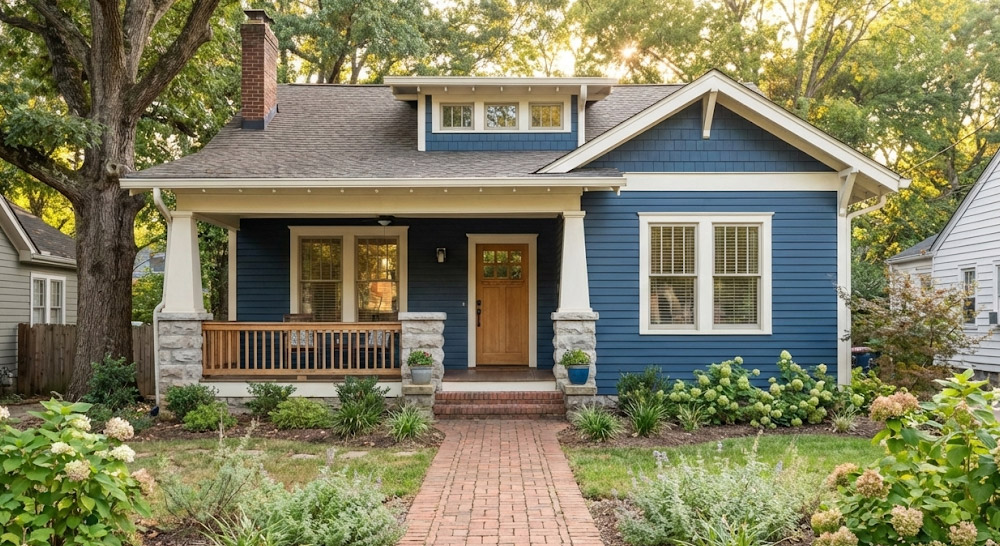
Design and architecture in East Nashville reflect more than a century of incremental growth rather than a single period of planned development. Many residential streets are lined with late-19th- and early-20th-century homes, including Victorian-era houses and Craftsman bungalows, alongside midcentury cottages and ranch-style homes built as the area expanded outward. Front porches, narrow setbacks, and detached garages are common, reinforcing a streetscape that prioritizes visibility and neighborhood interaction over uniformity or scale. Because development occurred over multiple eras, architectural styles often change from block to block, creating visual variety that is characteristic of the area.
More recent construction has added modern infill homes, townhomes, and small multi-unit buildings, particularly along larger corridors and near commercial nodes. These newer structures vary widely in form and materials, reflecting a mix of contemporary design approaches rather than a single aesthetic standard. Preservation and renovation also play a significant role, with many older homes updated to accommodate modern layouts while retaining original exterior details. The result is a built environment defined less by cohesion and more by layering, where historic architecture, adaptive reuse, and new construction coexist within the same neighborhoods, contributing to East Nashville’s distinctly lived-in and evolving character.
Housing at a Glance
Housing in East Nashville reflects the area’s long development timeline and neighborhood-level variation rather than a single dominant housing pattern. Home size, age, and layout can differ significantly from one block to the next, shaped by historic construction, midcentury growth, and more recent infill. The following overview provides a high-level snapshot of common housing characteristics across the region, with the understanding that individual properties and neighborhoods may vary.
| Metric | Description |
|---|---|
| Type | Predominantly single-family homes, with duplexes, townhomes, and small multifamily buildings present. |
| Age | Largely built from the late 1800s through the mid-20th century, with ongoing modern infill. |
| Styles | Victorian, Craftsman, Tudor Revival, midcentury ranch, contemporary infill |
| Size & Layout | Wide range, from small historic cottages under 1,200 sq. ft. to renovated and new-build homes exceeding 3,000 sq. ft. |
| Interior & Exterior Features | Front porches, hardwood floors, original trim in older homes; modern kitchens and additions common in renovated properties. |
| Lot Sizes | Vary significantly by neighborhood and block; generally, smaller urban lots compared to suburban Nashville. |
Real Estate Snapshot
The real estate market in East Nashville is shaped by limited inventory, neighborhood-level variation, and ongoing demand driven by proximity to downtown and established residential character. Conditions can differ meaningfully by block and housing type, with older homes, renovated properties, and newer construction often competing within the same submarkets. The following snapshot provides a high-level view of market patterns in the area, focusing on overall dynamics rather than specific prices or short-term trends.
| Metric | Summary |
|---|---|
| Market Demand | Consistently strong due to proximity to downtown, walkability, and neighborhood character. |
| Inventory | Limited; turnover varies by neighborhood. |
| Buyer Profile | Mix of long-term residents, professionals, creatives, and urban-oriented buyers. |
| Pricing Context | Above Nashville averages overall, but varies widely by neighborhood, block, and housing condition. |
| Investment Pattern | Combination of owner-occupied homes and long-term rentals; short-term rental rules subject to Metro Nashville regulations. |
Amenities & Local Conveniences
East Nashville offers access to everyday amenities without relying on large commercial centers. Groceries and basic services are available along major corridors like Gallatin Pike, where you can find big box stores like Kroger and Publix, plus independent favorites like Turnip Truck Natural Market on Woodland Street.
The East Nashville Branch Library serves as a community anchor. For recreation and wellness, the Margaret Maddox Family YMCA provides fitness facilities and youth programs. Dining and nightlife are major draws, with iconic spots like Lockeland Table for upscale-casual dining and Dino’s for a classic dive bar burger. The neighborhood is rich with independent boutiques, coffee shops, and restaurants that form the backbone of the local economy.
Schools & Education
Educational options serving East Nashville reflect the area’s size and neighborhood-level variation rather than a single, unified school pattern. Public school assignments depend on exact addresses and are subject to change, making individual verification an important step for families considering the area.
| School Level | Assigned Public School (MNPS) | Nearby Private School Options |
|---|---|---|
| Elementary | Multiple options (varies by address) | Montessori East, Lipscomb Academy (K-12) |
| Middle | Multiple options (varies by address) | Lipscomb Academy (K-12) |
| High | Multiple options (varies by address) | Father Ryan High School, Lipscomb Academy (K-12) |
Important: School zoning in East Nashville varies by address and is subject to change. Assignments must always be verified with Metro Nashville Public Schools.
In addition to K-12 options, East Nashville’s central location places residents within relatively short commuting distance of several major higher education institutions, including Vanderbilt University, Belmont University, Tennessee State University, and Lipscomb University. This proximity supports access to colleges, professional programs, and continuing education opportunities across the metro area without defining the day-to-day character of the neighborhoods themselves.
Commuting & Location
East Nashville’s location provides relatively direct access to major employment centers, entertainment districts, and regional transportation routes, while remaining distinctly residential in feel. Commute times and travel patterns vary by neighborhood and time of day, with most residents relying on personal vehicles for daily travel alongside limited transit and bike options. The following overview outlines typical access to key destinations across the Nashville Metro area, with the understanding that traffic conditions and specific starting points can significantly affect travel time.
| Destination | Approximate Drive Time* |
|---|---|
| Downtown Nashville / CBD | 5-10 minutes |
| Nashville International Airport (BNA) | 10-15 minutes |
| Midtown Nashville | 10-15 minutes |
| Vanderbilt / West End | 15-20 minutes |
*Drive times vary based on traffic conditions and exact starting location.
East Nashville Neighborhood Map
Quirks & Perks
A defining quirk of East Nashville is its deep support for small, independent businesses that are part of the area’s identity. Shops like Grimey’s New & Preloved Music host in-store performances, blurring the line between retail and culture. Porter Road Butcher has embedded itself into daily routines, and hybrid spots like Vinyl Tap (a bar and record store) reinforce the area’s creative spirit.
The neighborhood is also known for its resident-driven traditions, like the annual Tomato Art Fest, a quirky celebration of iconic fruit. Breweries such as Southern Grist Brewing Co. and Smith & Lentz Brewing contribute to local activity, while restaurant clusters in Five Points and Riverside Village encourage repeat visits. These perks reflect an area shaped by shared habits, where culture is built gradually through everyday places.
Neighborhood Logistics
Living in East Nashville comes with practical considerations shaped by its age, layout, and role within Metro Nashville government rather than by neighborhood-specific governance. Most areas do not have mandatory homeowners associations, and property upkeep, renovations, and land use are governed by city zoning and permitting rules rather than uniform neighborhood standards. Utilities, trash pickup, and public services are provided through standard metro systems, and service levels can vary slightly by street and housing type.
Parking, transportation, and property use are handled at the block level more than the regional level. On-street parking is common in many neighborhoods, with availability influenced by housing density and proximity to commercial corridors. Short-term rental rules, permitting requirements, and occupancy limits are set by the city and subject to change, making compliance an important consideration for property owners. While some residents use transit, biking, or walking for daily errands, most households rely on personal vehicles, especially outside the most walkable pockets. Overall, East Nashville operates with fewer formal structures than planned communities, placing more emphasis on citywide regulations, neighborhood norms, and individual property responsibility.
Explore Nashville Neighborhoods
Note on imagery: Images marked “AI Generated” are visuals to illustrate the neighborhood homes, atmosphere and architectural style. To protect homeowner privacy, these images are artistic representations and do not depict specific existing properties.