Why Do People Move? The Top Reasons for Relocation, According to Census Data

Over the last few years, many people have joined the ranks of relocators, uprooting their lives and homes to start fresh in a new city.
How Many Americans Move Each Year?
In 2023, about 25.6 million Americans moved to a new home. That is roughly one in every 13 people.
Though these numbers are slightly lower than historical data, that’s still a massive share of the population in the business of relocating. Moving rates have kept falling since then, reaching a record low in 2024.
If you’re contemplating making a move and aren’t sure where to start, we’re here to help.
The Top Reasons for Relocation
The U.S. Census Bureau tracks why people move every year. According to its latest data, more than 4 in 10 movers said housing was why they relocated.
Those reasons include wanting better neighborhoods and better homes, wanting to own rather than rent and less pleasant reasons like being evicted.
The top five reasons why Americans move are:
- A new or better home/apartment (13.8%)
- New job or job transfer (12.5%)
- To establish own household (9.7%)
- Wanted cheaper housing (9.4%)
- A family reason (other than getting married or starting a household) (7.9%)
Housing, Family, Jobs and More: The 4 Big Categories
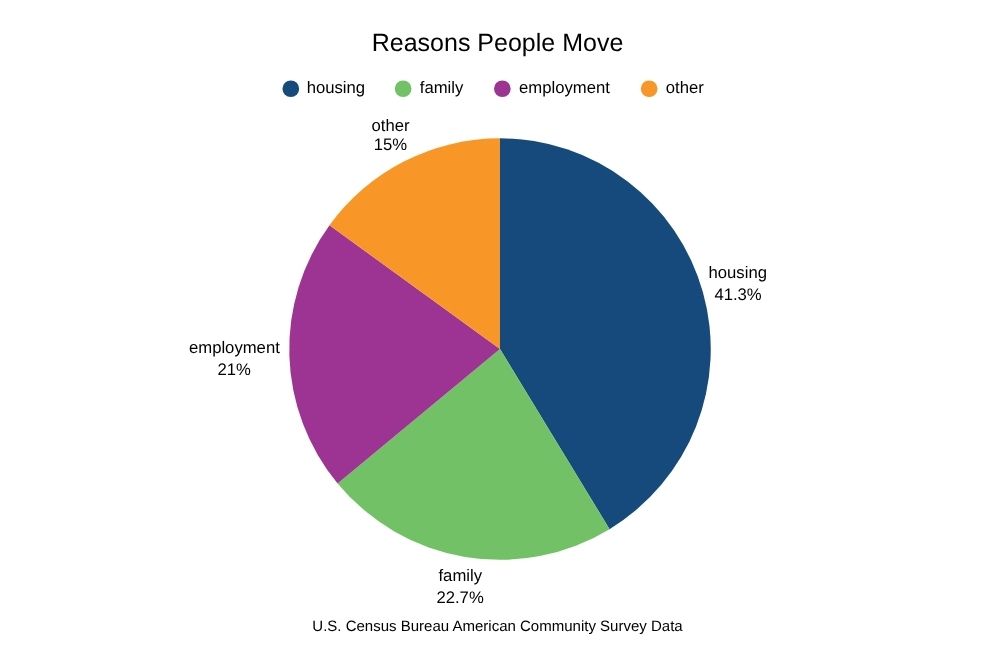
The Census groups the reasons for moving into four overarching categories: housing (41.3%), family (22.7%), employment (21%) and other (15%).
Local Moves vs. Long-Distance Moves
More than half of movers stay within their county. In other words, most moves are incredibly local.
Think of moving from a city’s downtown district to a nearby neighborhood that’s more securely in the suburbs.
If you look at why these two groups of movers relocate, you start to see some stark differences in the reasons. People who move within the same county are more than twice as likely to do so for housing-related reasons as those who move to a different county.
The reasons people move to other counties are more spread out, with jobs leading the way, followed by housing and family. In contrast, same-county movers do so disproportionately for housing-related reasons.
Those who stayed in the same county were substantially less likely to cite new jobs than those who moved to different counties. Instead, they overwhelmingly said housing drove their moves.
What the Data Can’t Tell Us
We know demographic shifts drive changes in what people look for in housing. For example, how many people moved because they had another child? Does having a first child predict a move better than having a third?
At what point does a move happen because of schools instead of space? What percentage of people who are newlyweds move? How does that compare to the percentage of newly divorced people who move?
These are all great questions we can’t really answer with this data. But we can guess a little here and there, and regardless, we get a clear picture that the reasons for moving are complicated and vary significantly between groups, especially by the distance of the move.
Ready to Make Your Move?
Want to learn more? We conducted a survey that asked these questions and studied Americans’ relocation habits. You can find that information here.
This can be overwhelming, and we’re here to help. Check out our latest ranking of the annual Top 100 Best Places to Live in America.
📬 Where to Next?
Love discovering hidden gems and communities across America? Sign up for our newsletter to get expert relocation advice, travel inspiration and city rankings delivered straight to your inbox.
Related Content