
How Southern Idaho Became the “Trout Capital” of the US
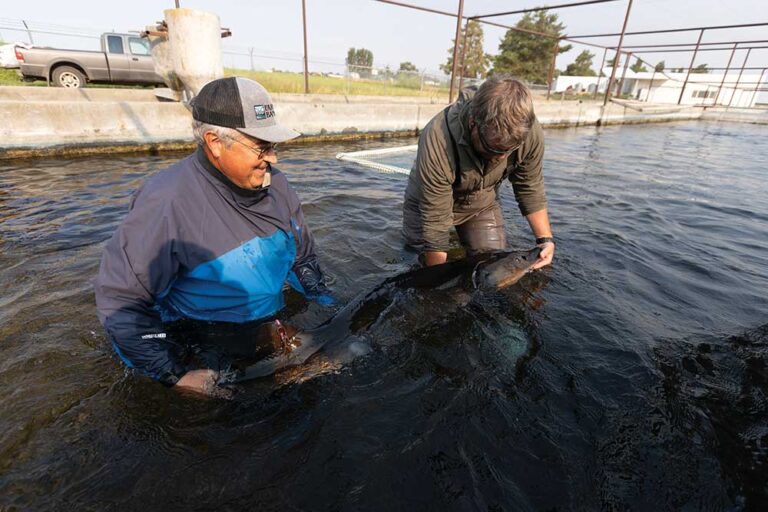
Idaho’s world-famous vegetable has a lesser-known but equally important counterpart.
“We’re the nation’s trout capital. Trout are to Idaho what potatoes are to Idaho,” says Jeff Koehn, who has been raising fish since 1994.
For the past 18 years, he’s run Koehn Trout Farms in Buhl, west of Twin Falls. Though he gets help from his wife and kids, “I’m basically a one-man team,” Koehn says. “I process in small batches. Every fish is hand filleted and immediately put on ice. That’s very important with trout. My products don’t have a fishy flavor.”
Koehn sells fresh and frozen fillets as well as smoked trout in six flavors. Several Southern Idaho stores and restaurants offer his fish, but he spends a lot of time selling in person, too.
There are around 80 fish farms in the Magic Valley
“Farmers markets are huge for me, especially Hailey and Ketchum,” he says.
Koehn Trout Farms is one of about 80 fish farms in the Magic Valley — home to approximately 98% of Idaho’s aquaculture production. The Gem State produces about 70% of America’s trout, which is even more impressive considering nearly 95% of all trout destined for U.S. dinner tables is farm-raised. Other fish are produced in Southern Idaho, too, including tilapia, catfish and sturgeon.

In This Article
Idaho Springs Foods: From Sturgeon to Caviar
Near Twin Falls in Filer, Idaho Springs Foods raises sturgeon for its meat and caviar.
“People are always pleasantly surprised when they taste the buttery, nutty notes of Idaho white sturgeon caviar,” says Linda Lemmon, one of the company’s processing managers and the wife of one of the owners.
For 20 years, Idaho Springs Foods has been slowly developing its caviar production.
“It takes four years before we can determine the sex. Most of our caviar is made from 13- to 15-year-old females,” Lemmon says.
And while diet and water temperature are essential, the most significant factor is Southern Idaho’s water quality. Lemmon says that Sturgeon raised in spring water are clean and mild tasting, not fishy.
The Magic of the Magic Valley: Spring Water’s Role in Aquaculture
Winding across Southern Idaho, the Snake River is the region’s lifeblood. Close to Twin Falls is a 30-mile stretch called the Thousand Springs Reach.
“Nowhere else in the U.S., and perhaps the world, is there an area with as much spring water as is concentrated here,” Lemmon says. “The spring water is vitally important to the Snake River itself, for this section would be completely dry if it weren’t for the spring flows.” The underground aquifer supplies water for drinking, power generation, irrigation, recreation and fish farming. It’s oxygen-rich and the perfect temperature for aquaculture, particularly rainbow trout.
Idaho produces about 70% of domestic trout in the nation
Troutlodge: Research and Development for a Global Market
The setting also makes Twin Falls superior for research and development.
“We saw it as a strategic location,” says Kyle Martin, the senior geneticist for Washington state-based Troutlodge. “The vast majority of what we do is sell genetically improved eggs to the seafood market worldwide.”
In 2019, Troutlodge converted Twin Falls’ Rock Creek Hatchery into a cutting-edge research facility. The farm setting and optimum conditions provide a baseline for developing trout that thrive in more than 60 countries.
“Diseases are a big challenge based on whatever is endemic to the area, so we focus a lot on disease resistance,” Martin says.
Idaho trout production averages around 41 million pounds per year
Fish Farms Feed the World
Southern Idaho’s fish farms provide a sustainable protein regardless of the species.
“Aquaculture, in general, is growing throughout the world, as demand increases and supply for wild-caught fish gets depleted,” Martin says.
So, the industry’s impact on the local economy is extensive. “Our use of water is nonconsumptive. Fish drink a minute amount, so the vast majority flows into the Snake River,” Lemmon says. “Directly and indirectly, the Idaho aquaculture industry employs a number of people on farms, at supporting industries like feed and equipment, and at universities through research and extension services.”
And fish farming is generally a fun challenge.
“Raising trout is like anything else: Experience is paramount. Nature is constantly throwing curves at you,” Koehn says. “But I’m having a good time! I love meeting my clients. I love that personal connection.”
Get to Know Southern Idaho
Want to learn more about living and working in Twin Falls and Southern Idaho? Check out the latest edition of Livability Southern Idaho.