
Winston-Salem’s Innovation Quarter Expands Biotech and Research

The energy within Winston-Salem, North Carolina’s Innovation Quarter (iQ), a mixed-use district anchored by Wake Forest University School of Medicine, is unmistakable.
It thrives on a dynamic blend of research, entrepreneurship, academia and community, all of which come together to foster collaboration.
Now, the district is entering a transformative new phase. Already recognized as a national model for innovation districts, iQ has set the stage for the future footprint of iQ Phase II. This bold 28-acre development of recently completed horizontal infrastructure lays the groundwork for future scientific breakthroughs, business growth and high-impact partnerships.
“Phase II of the Innovation Quarter will capitalize on momentum we’ve been generating in our community over the last 20 years,” says Jason Kaplan, associate vice president of Innovation Quarter operations. “We are seeing tremendous collaboration opportunities between research, industry and clinical partners driving more investment into our city, more jobs to the region and, as a result, more space needed for the continuation of what has largely been a successful effort in district building.”
A New Chapter
Phase II will feature up to 10 new buildings and approximately 2.7 million square feet. Building upon the success of the mixed-use development of the existing district, Phase II will also emphasize lab, clinical and office space for industry partners, meeting growing demand from biotech and life sciences companies seeking modern, adaptable environments. Plans also include residential, retail and hospitality elements to continue to support a live-work-play community in the heart of downtown.
Currently, iQ, which was made possible through a public-private partnership, has an estimated annual economic impact of $2 billion. The Phase II expansion will double the district’s footprint, building on more than two decades of planning, and it will help elevate the region as a premier destination for life science and technological innovation.
Today, more than 150 companies and organizations operate within iQ, and that number is rising. In 2024, Charter Medical established its Innovation Hub in iQ. This operation supports biopharma’s cold chain logistical needs and the development of critical therapeutics through the engineering of single-use products.
In 2025, PepGel relocated from Kansas to join the district. The company develops hydrogel solutions and standard cell culture systems, with applications for stem cells, organ regeneration, 3D printing and drug delivery opportunities.
Fueling Biotech
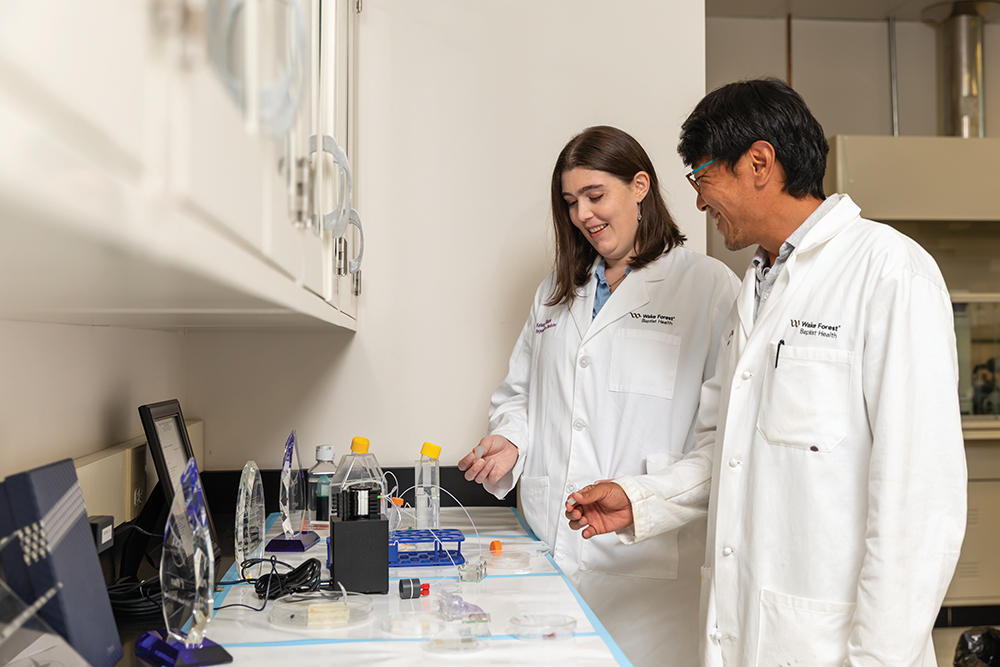
A key magnet for many is the Wake Forest Institute for Regenerative Medicine (WFIRM) that’s headquartered in iQ. Known worldwide for its breakthroughs in lab-grown organs, tissue engineering and cell therapies, WFIRM attracts top scientists and collaborators from across the globe. Its work is helping define the future of medicine.
“When WFIRM became the first scientific anchor tenant in iQ nearly 20 years ago, we could not have predicted how quickly we’d fill up our 200,000-square-foot building, from internal growth and outside companies wanting to be near our research,” says Dr. Anthony Atala, executive director of WFIRM. “Phase II, with up to 1 million square feet of lab, clinical and office space, will allow Winston-Salem’s regenerative medicine ecosystem to continue its growth trajectory.”
As part of iQ’s broader strategy to grow capacity in step with market demand, Phase II planning emphasizes biotech and regenerative medicine, providing WFIRM and other industry partners with the opportunities needed to expand their footprint.
With additional infrastructure in place, researchers, industry partners and clinicians can increase the volume and scope of their work, move projects more quickly from ideation to application and deepen collaborations that lead to real-world treatments.
“As companies move from idea to commercialization, so do their unique needs, including what physical environment will best support them,” says Isaac Perry, head of biotech and life science ecosystem development for iQ. “We are working to create flexible lab infrastructure that brings together key components of the commercialization process in the same building to help companies de-risk their processes and technology and reduce the time needed to reach the patient.”
Get to Know Greater Winston-Salem
To learn more about the region and all it has to offer, visit livability.com/nc/winston-salem.