

Education in Fort Mill, SC: Top Schools, Colleges & Lifelong Learning
Ask local real estate professionals why families relocate to Fort Mill, South Carolina, and you’ll hear the same answer again and again: the schools.
While Fort Mill offers attractive neighborhoods, convenient access to Charlotte, abundant parks, and a strong sense of community, education is often the deciding factor for families choosing where to live. The Fort Mill School District has earned a reputation as one of South Carolina’s premier public school systems, consistently ranking among the top districts in the state and attracting families from across the Carolinas.
For many parents, buying a home in Fort Mill isn’t simply about finding a neighborhood they love. It’s about gaining access to a school district known for academic excellence, strong extracurricular programs, and a culture that places a high value on student success.
That commitment to education has become one of Fort Mill’s defining characteristics and one of the community’s greatest assets.
Key Education Providers at a Glance
| Institution | Type | Students / Scale | Highlight |
|---|---|---|---|
| Fort Mill School District | Public K-12 | 18,000+ students · 21 schools | Top-ranked SC district; 95.7% graduation rate and a National Blue Ribbon elementary |
| Winthrop University | Public University (Rock Hill) | ~5,300 students | Nearest four-year public; business, education, arts & sciences |
| York Technical College | Community & Technical College (Rock Hill) | 100+ programs | Associate degrees, dual enrollment, and workforce training |
| Clinton College | Private HBCU (Rock Hill) | Small four-year | Faith-based bachelor’s in nursing, cybersecurity, and business |
| Ascent Classical & Riverwalk Academy | Public charter | Tuition-free (K-9 / K-12) | Classical and project-based school-choice options |
K-12 Options: Public Districts & Private Schools
Fort Mill School District serves more than 18,000 students across 21 school sites, including 12 elementary schools, six middle schools and three high schools. Students can pursue advanced academics, career and technical education, dual enrollment, fine arts, athletics, and work-based learning.
Families seeking alternatives can also consider the district’s limited school-choice program, local and nearby charter schools, and private Christian schools. Higher education options in nearby Rock Hill and Charlotte include four-year universities, technical and community colleges, short-term career training, and adult education.
Public Education: Fort Mill School District
Fort Mill School District serves students in Fort Mill, Tega Cay, and surrounding portions of York County. Although the district covers only about 52 square miles, it has experienced sustained enrollment growth as new neighborhoods have developed throughout the area.
That growth has required the district to add schools, expand facilities, and periodically adjust attendance boundaries. Even as enrollment has increased, Fort Mill schools have continued to perform well on state measures. The district reported a 95.7% four-year graduation rate for the 2023-24 school year, compared with 85.4% statewide, and 87.2% of the Class of 2024 met South Carolina’s college- or career-readiness standard.
Elementary education remains one of the district’s most visible strengths. Gold Hill Elementary School, for example, was named a National Blue Ribbon School in 2022. Other campuses have earned recognition for academic performance, literacy, school culture, and student support, giving families strong options across several attendance areas rather than concentrating the district’s reputation in one or two schools.
As students move into middle school, the curriculum expands to include fine arts, world languages, athletics, technology, clubs, and introductory career exploration. The district operates six middle schools: Banks Trail, Forest Creek, Fort Mill, Gold Hill, Pleasant Knoll, and Springfield.
Fort Mill’s three comprehensive high schools are Fort Mill High School, Nation Ford High School, and Catawba Ridge High School. Students can build schedules around Advanced Placement and honors courses, dual enrollment, performing arts, athletics, student organizations, and career-focused electives.
The district’s career and technical education programs provide pathways in accounting, automotive technology, biomedical sciences, cosmetology, culinary arts management, digital art and design, engineering, health science, marketing, media technology, programming and software development, sports medicine, and plant and animal systems.
Partnerships with York Technical College expand those choices to include programs such as building construction, cybersecurity, emergency medical services, mechatronics, and welding. Winthrop University partnerships support accounting coursework and the Teacher Cadet program for students interested in education careers.
These pathways allow students to prepare for different kinds of post-graduation plans. One student might build a conventional college-preparatory schedule around AP courses, while another combines high school classes with technical training, industry credentials, or college credit.
Magnet, Choice, and Charter Schools
Rather than operating a separate network of magnet schools, Fort Mill School District places most advanced, technical, and interest-based programs within its neighborhood middle and high schools.
The district also offers a Limited School Choice Lottery that allows eligible families to apply for space at selected elementary and middle schools outside their assigned attendance zones. For the 2026-27 school year, participating campuses include Fort Mill, Springfield and Sugar Creek elementary schools, along with Banks Trail, Fort Mill and Springfield middle schools.
The number of available seats varies by school and grade, and a lottery is used when applications exceed capacity. Families accepted through the program must provide their own transportation, so the practical value of a placement may depend on the distance between home, school, and work.
Fort Mill families can also consider public charter schools, which operate independently from the district and use their own application procedures.
Ascent Classical Academy-Fort Mill, also known as Carolina Classical Academy, is a tuition-free public charter school in York County. The school’s authorizer lists it as serving students in kindergarten through 10th grade, using a classical-education model focused on literature, history, mathematics, science, the arts, and civic character. Families should confirm current grade offerings and enrollment procedures directly with the school because charter schools often add grades as they grow.
Riverwalk Academy, located in western Rock Hill, provides another nearby option for students in kindergarten through grade 12. Its project-based learning model encourages students to apply academic concepts to complex questions, collaborative work, and practical problems.
Charter schools do not follow Fort Mill School District attendance assignments. Families should compare academic models, grade levels, application deadlines, transportation, and extracurricular opportunities before deciding whether a charter school is a practical alternative to the assigned neighborhood campus.
Private and Independent Academies
Fort Mill’s private-school offerings are primarily Christian and include options extending from the elementary years through high school.
Walnut Grove Christian School is a K-12 school on Maxwell Mill Road. It combines Christian instruction with an accredited academic program and offers honors and college-preparatory courses at the high school level.
The school reports average class sizes of 13 students in elementary grades and 15 in middle and high school. Students can participate in athletics, music, drama, and other activities, while college guidance begins before the high school years and continues through graduation.
Kingdom Leadership Academy is a private Christian school on Regent Parkway serving students from prekindergarten through grade 12. Its educational model combines academics and biblical instruction with an emphasis on leadership, resilience, and entrepreneurial thinking.
Additional private-school choices are available in Rock Hill and Charlotte, including schools with Catholic, college-preparatory, and independent-school models. These options can broaden a family’s choices, but they may also add a longer commute across Rock Hill or into North Carolina.
Private schools establish their own admissions schedules, tuition, financial aid policies, and transportation arrangements. Families should ask about grade-level availability, class size, academic support, extended-day care, athletics, arts, and expectations for participation in religious instruction.
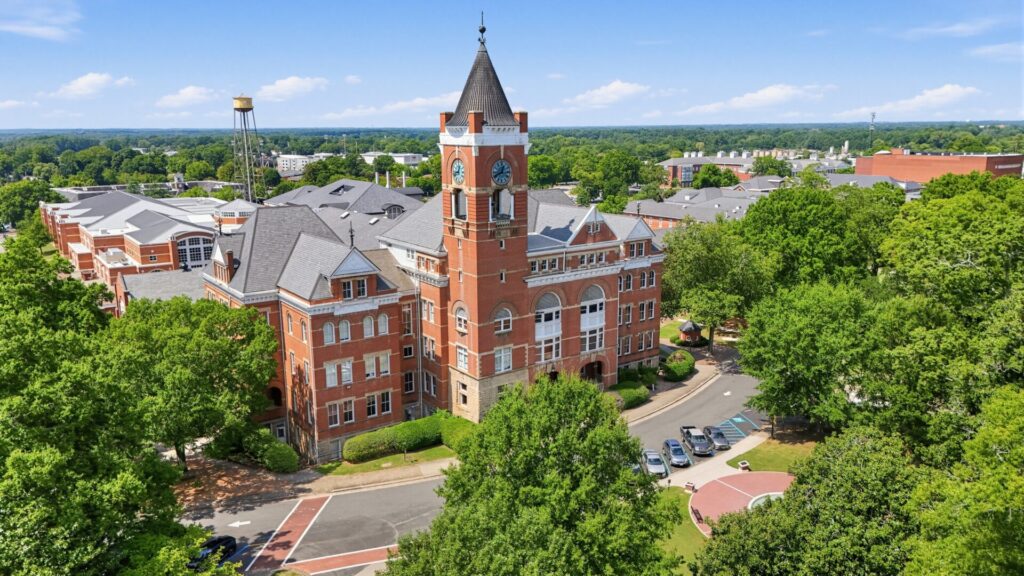
Higher Education
Fort Mill does not have a large traditional college campus within town limits. Still, its location between Rock Hill and Charlotte gives residents access to four-year universities, community and technical colleges, graduate programs, and professional training.
Four-Year Colleges
Winthrop University is the closest large four-year public institution. Located in Rock Hill, the university enrolled nearly 5,300 students in fall 2025 and offers bachelor’s and master’s degrees through both campus-based and online programs.
Academic opportunities span business and technology, education and leadership, arts and sciences, and visual and performing arts. Students can pursue fields such as business administration, computer science, communications, education, health-related disciplines, social work, the sciences, and the arts.
Winthrop also provides cultural and recreational resources for residents who are not enrolled. Division I athletics, theater, music, galleries, lectures, and public events make the campus part of the broader York County community.
Clinton College in Rock Hill offers a much smaller four-year environment. The private historically Black college provides bachelor’s programs in biology, business administration, cybersecurity, elementary education, health care administration, interdisciplinary studies, music, nursing, and religious studies.
Its mission connects academic study with leadership, faith, community service, and social change. The college also offers associate degrees and is adding a fully online general MBA beginning in fall 2026.
Students willing to commute north can access additional institutions in Charlotte. UNC Charlotte is a large public research university with programs in engineering, computing, business, architecture, education, health, and the sciences. Queens University of Charlotte offers a smaller private university setting with undergraduate, graduate, and professional programs.
For Fort Mill residents, the choice between Rock Hill and Charlotte campuses may depend as much on scheduling and transportation as on academics. A campus that appears close by mileage can require a substantially longer trip during Interstate 77 traffic.
Community Colleges and Technical Schools
York Technical College in Rock Hill is the primary community and technical college serving Fort Mill and the surrounding region.
The college offers more than 100 programs leading to associate degrees, diplomas, and certificates. Students can prepare to transfer to a four-year institution or enter a career-focused program in health care, business, computer technology, industrial and engineering technology, construction, public safety, and skilled trades.
Programs include nursing and allied health, cybersecurity, automotive service, industrial maintenance, engineering technology, HVAC, welding, information technology, and business administration. Short-term programs in health care, manufacturing, construction, public safety, and information technology may lead to employment in as little as six weeks, depending on the credential.
York Tech also provides dual enrollment to high school students throughout York, Chester, and Lancaster counties. Fort Mill students can use these partnerships to begin college coursework or technical training before graduation.
Central Piedmont Community College offers another extensive set of options in Charlotte. Its degree, diploma, certificate, and continuing education programs cover fields ranging from health care and information technology to advanced manufacturing, automotive systems, and construction.
York Tech will often be the more straightforward in-state option for Fort Mill residents. Central Piedmont may still be worth considering when it offers a particular specialty, schedule, or connection to a Charlotte employer that is not available closer to home.
Adult Education & Lifelong Learning
Adults do not have to enroll in a conventional two- or four-year degree program to continue their education.
Tri-District Adult Education serves Fort Mill, Clover, and York. Its programs include GED preparation, high school diploma completion, instruction in reading, writing, and mathematics, and English for Speakers of Other Languages. Fort Mill residents can access both local and online learning options.
York Technical College provides short-term credentials, apprenticeships, professional development, and employer-focused workforce training. Programs serve adults entering a new industry, updating existing skills, or pursuing a credential without committing to a full degree.
The college’s Workforce and Economic Development offerings include business and professional training, health and safety, industrial trades, transportation, and logistics. Customized programs can also be developed around the needs of area employers.
Winthrop University offers continuing and professional education for adults seeking career development, industry knowledge, or a professional credential. Depending on the program, participants may earn continuing education units, certificates, or digital badges through in-person, hybrid, or online instruction.
Together, these options create several entry points into education. A resident can complete a high school credential, learn English, earn a technical certificate, begin an associate degree, or return later for professional development without following a single fixed path.
A Community That Values Education
One of the reasons Fort Mill schools continue to perform at a high level is the support they receive from the broader community.
Parents are highly engaged in school activities, fundraising efforts, and volunteer opportunities. Local businesses also support career exploration, internships, work-based learning, and other connections between the classroom and the regional economy.
Education is not viewed as solely the responsibility of teachers and administrators. Instead, it is often treated as a community-wide priority.
For many families, that sense of investment is just as important as test scores and rankings.
Why Education Is a Fort Mill Advantage
Many communities offer good schools.
Few communities have built their identity around them.
In Fort Mill, education is more than a public service. It is one of the primary reasons people choose to live here. Families are drawn by a district that consistently performs among the best in South Carolina, schools that earn statewide and national recognition, and a community that actively supports student success.
From highly regarded elementary schools such as Gold Hill Elementary to strong middle-school programs and high schools that prepare students for life after graduation, Fort Mill has created an educational environment that continues to attract families from across the region.
Nearby charter and private schools, technical training, adult education, and higher education options give residents additional pathways as their needs change.
Pairing School Zones with Neighborhood Scouting
Consider the Commute
School assignments in Fort Mill begin with the property address.
Students generally attend the school connected to their permanent residence, and families must live within Fort Mill School District boundaries to enroll. Because a Fort Mill mailing address does not always guarantee placement in Fort Mill School District, families should verify every prospective address directly with the district rather than relying on a real estate listing.
Growth makes that verification especially important. The district has added campuses and adjusted attendance lines as enrollment has increased. Some schools may also experience enrollment freezes, so information from an older listing or neighborhood discussion may no longer reflect current assignments.
Alternative programs add another layer to the commute. Families participating in the Limited School Choice Lottery must provide their own transportation. Charter and private schools set separate transportation policies, while high school students may travel to York Tech or another site for technical and dual-enrollment courses.
The most useful test is not simply the number of miles between home and school. Families should drive the route during actual arrival and dismissal periods and consider how it fits with work, child care, athletics, and the schedules of other children.
Plan a Scouting Trip
Begin an education-focused scouting trip by identifying the elementary, middle, and high schools assigned to each prospective address.
Once those assignments are confirmed, narrow the list of alternatives to schools and programs that meet the student’s actual needs. These might include a limited-choice district school, a charter school, a private school, or a career pathway offered through York Technical College.
Schedule tours or information sessions whenever possible. Ask about class size, academic support, before- and after-school care, athletics, arts, technical programs, dual enrollment, and how specialized opportunities operate during a typical school day.
Families considering charter or private schools should confirm application dates, lotteries, tuition, financial aid, and transportation. Older students can use the same trip to visit York Tech, Winthrop, Clinton, or a Charlotte-area institution and compare campus culture, program length, transfer opportunities, and career services.
Finally, repeat the likely routes during the hours the household would actually travel. A school or college may be an excellent academic match but still create a schedule that is difficult to sustain from a particular neighborhood.