
Innovation Is Key in Agricultural Endeavors at Fort Valley State University
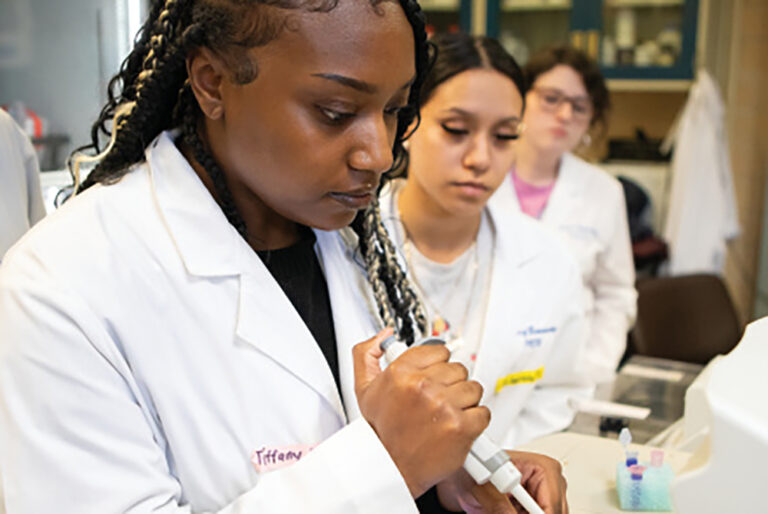
At Fort Valley State University, agriculture is paramount.
The College of Agriculture, Family Sciences and Technology offers four departments geared toward different areas of study: agricultural sciences, engineering technology, family and consumer sciences, and veterinary science and public health.
Seated on 1,300 acres, the campus provides the resources for research projects, hands-on learning experiences and collaborative ventures with some of the state’s largest entities. As the top public Historically Black College and University (HBCU) in Georgia, FVSU has become a center for innovative research and also offers graduate degrees in animal science, biotechnology and public health.

In This Article
Creating Sustainable Solutions for Education
For Cedric Ogden, becoming a faculty member at FVSU meant coming home to the university he attended as an undergraduate. Ogden, who holds a doctoral degree in agriculture and biological engineering, has been at FVSU for 12 years, working as a researcher, professor and extension specialist in agricultural engineering technology. His research focuses on how natural resources can be utilized to improve sustainability.
“I tie agriculture, technology, and natural resource sustainability and efficiency into one,” Ogden says.

One of Ogden’s ongoing research projects involves finding innovative ways to implement solar energy. FVSU is home to an 11-megawatt solar farm, one of the largest on a U.S. campus. Through a partnership with Georgia Power, the farm provides energy for 5,000 homes in the area. The renewable energy demonstration site, as Ogden terms it, also serves as a hands-on learning opportunity for students, as well as local landowners and farmers interested in solar energy.
For Ogden, innovation in agriculture is essential when it comes to facing changes in the industry and environment. “Innovation allows us to better face these evolving challenges that we have taking place,” Ogden says. “It helps us be more efficient with our natural resources and, ultimately, allows us to increase our sustainability.”
Crops Grown at Home
The ongoing research at FVSU has had a significant impact on the surrounding community, specifically the agricultural producers who can benefit from scientific findings.
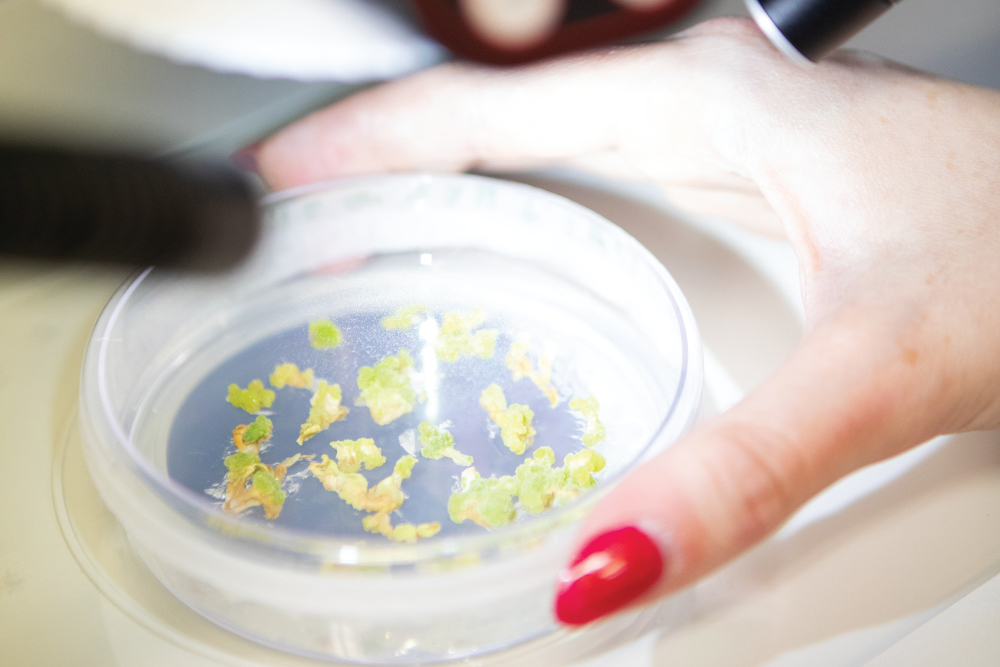
George Mbata, chair and professor of the Biology Department at FVSU, is committed to finding ways to protect Georgia crops from insect infestation.
Fighting crop pests has a major impact on the economy and the livelihoods of farmers in the region. Mbata’s research has centered primarily on some of Georgia’s major crops, including peanuts and vegetables such as snap beans, squash and tomatoes. Peanuts are a $2.2 billion industry in Georgia, according to the Georgia Peanut Commission, with 52% of all U.S. crop production occurring in the state.

By fighting pests that target peanuts, Mbata’s research aims to bolster and protect this industry.
FVSU researchers, like Ogden and Mbata, can see firsthand how their work benefits the community. Ogden recalls working on a U.S. Department of Agriculture-funded project through FVSU to help address a pine beetle infestation in the area, which allowed him to give insights to local farmers.
“Innovations like precision farming, biotechnology and all these smart technologies that we have are able to contribute to increased production, reduce environmental impact, and create more resilient agricultural systems,” Ogden says.
Contributing to the Future of Farming
FVSU remains committed to developing the workforce for agricultural industries and creating new hands-on learning experiences, especially through research projects led by faculty members.
From studying at the renewable energy demonstration site to interacting with farmers in the community, FVSU students are set up to begin their careers at some of the state’s and the nation’s largest agricultural agencies.
“Many former students of FVSU who studied agriculture work for such organizations as the U.S. Department of Agriculture, Environmental Protection Agency or the Georgia Department of Agriculture,” Mbata says. “To prepare our students for Georgia agro-industries, faculty tailor instructions to crops cultivated in Georgia.”
Ogden attests that, when innovation comes up in the classroom, students’ eyes light up. Finding new solutions and implementing cutting-edge technology is a way to keep students interested in agriculture to ensure its sustainability.
“Students are our future,” Ogden says.
Fort Valley State University Accolades
No. 1
Public Historically Black College and University in Georgia
U.S. News & World Report
No. 8
Best Value Historically Black Graduate Schools
Best Value Schools
Top 10
Regional performer in advancing social mobility
U.S. News & World Report

5 FVSU Graduates and Their Impressive Careers in Agriculture and Animal Science
Fort Valley State University (FVSU) produces graduates that impact all industries, but it especially shines in the fields of agriculture and animal science.
Over the years, FVSU has gained a reputation as a trailblazer, shaping the careers of people with significant legacies.
Otis Samuel O’Neal
A graduate of the class of 1908, Otis Samuel O’Neal revolutionized rural agricultural education, teaching impoverished farmers how to acquire land and diversify crops.
He was the founder of the Ham and Egg Show, one of the first and largest African American agricultural gatherings in history.
Josiah Phelps
The first African American executive secretary of the Georgia chapter of the Future Farmers of America and, previously, the executive secretary of its African American counterpart, the New Farmers of America, Josiah Phelps (class of 1949) was instrumental in merging the two groups. Phelps held the first of many titles, including as the first minority to be president of the Future Farmers of America National Alumni Association and as the first African American inductee of the Georgia Agricultural Hall of Fame.
Dr. Vernard L. Hodges & Dr. Terrence Ferguson (pictured above)
The duo behind the National Geographic television show “Critter Fixers” are graduates of FVSU. Dr. Vernard L. Hodges graduated from FVSU in 1993 as a fish biologist before continuing on to Tuskegee University School of Veterinary Medicine. Because of his love of animals, Dr. Terrence Ferguson was encouraged by family to study veterinary medicine, and while at FVSU, he worked with the U.S. Fish and Wildlife Service at Alaska’s National Wildlife Refuge and the Patuxent Research Refuge.
Ralph McDaniel Paige
Known as the “Champion of Black Farmers,” Ralph McDaniel Paige graduated from FVSU in 1967 and led the effort to secure more than $2 billion for 15,000 Black farmers in the largest successful discrimination lawsuit against the federal government in U.S. history.
– Rebecca Treon