
Mission Critical: How Wright-Patterson Air Force Base Drives Defense Contracting in Dayton, OH
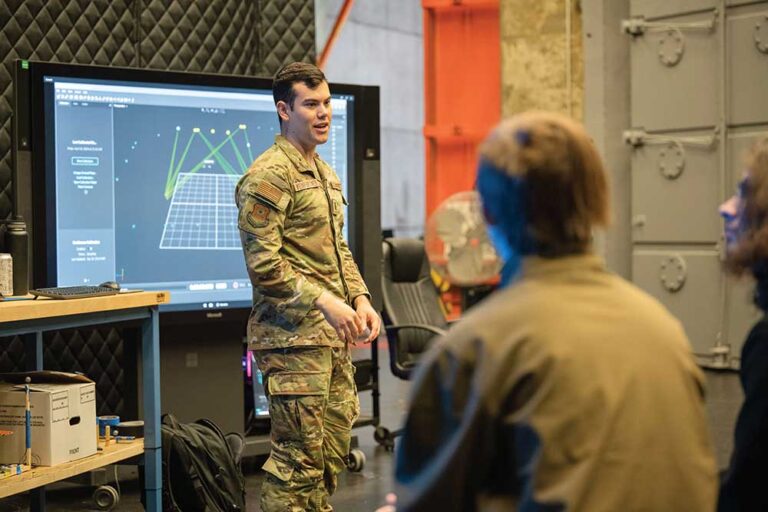
Just 5 miles from downtown Dayton stands Wright-Patterson Air Force Base (WPAFB), one of the nation’s preeminent military installations – and, with nearly 40,000 employees, the state of Ohio’s largest single-site employer.
In addition to its several considerable military functions – the base is home to the 88th Air Base Wing and the National Museum of the U.S. Air Force, to name just two – Wright-Patterson Air Force Base serves as an unmatched economic partner and customer for regional vendors. Small business has a massive impact on daily military operations, according to Luke Schultz, the base’s principal liaison with the local commercial community.
For local entrepreneurs and suppliers exploring defense contracting in Dayton, OH, this collaborative relationship provides a reliable framework for long-term commercial growth.
“It’s mission critical and a strategic partnership that helps sustain operational readiness and the warfighter,” he says.
Schultz serves as the Small Business Office (SBO) director at the base for the Air Force Life Cycle Management Center (AFLCMC), which manages the life cycle of Air Force weapons systems from inception to retirement. Schultz emphasizes that the SBO functions as the primary advocate and champion for small business integration throughout AFLCMC.
“We’re the front door to help small businesses work with AFLCMC,” Schultz says.
In fiscal year 2025, he notes, AFLCMC did business with nearly 1,100 small businesses overall. Some 260 of those businesses are in the Dayton area, where AFLCMC spent $625 million.

In Lockstep: Local Guidance via the Ohio APEX Accelerator
Many area small businesses fortunate enough to secure contracts with Wright-Patterson received crucial preparation from Billy Grill, who has helped companies market products and services to governments at various levels for over 20 years.
Grill is based in Dayton and serves as an associate director of the Ohio APEX Accelerator at Ohio University in Athens. He explains that APEX is a nationwide network of centers, funded by the U.S. Department of Defense, that offers free support services for business owners interested in winning local, state or federal contracts.
“The base partners well with us, and it creates a stronger ecosystem because we’re in lockstep.”
Billy Grill, Ohio APEX Accelerator
“It’s a national organization, but with very localized knowledge,” he says. “The federal government literally talks in code, and I’m a great translator.”
Dayton and Wright- Patterson do “a really good job of supporting each other,” Grill says.
“They truly take a community approach. The base partners well with us, and it creates a stronger ecosystem because we’re in lockstep.”
From Toilet Paper to Torpedoes: Becoming Procurement-Ready
Grill says his job is to educate small-business owners interested in making a deal with the base on how to get “procurement-ready.”
“It takes a few months to get the basics down to where you’re able to bid,” he says. “Is that going to be enough to win the first contract you bid? Probably not. It’s constantly teaching and learning, and it’s never foolproof.
“Whenever you look to move into a new market, there’s inherent risk – time, energy, money, resources. Government’s no different. But we’re here to try to demystify the process,” he says.
Grill says the businesses he’s helped with Wright-Patterson range from hypersonic weapons to a local landscape company.
“I tell my clients that the government buys everything from toilet paper to torpedoes,” he says. “We could be helping a janitorial company one day, then sit down with, literally, a rocket scientist the next day.”
That landscaper was memorable, Grill says, because it was one of those rare first-time wins.
“A young guy, 23, ambitious, decides he’s going to start this business,” Grill says. “He bids a job in a park the U.S. Army Corps of Engineers was running, $100,000 a year for five years to maintain that huge park.
“That company doesn’t exist if he doesn’t win that bid, and we were able to see him to the finish line,” he says. “The steady, predictable income is so invaluable to small business – now he’s got that stability taken care of, so he can start thinking about growth strategies.”

Cybersecurity Hygiene: An Investment, Not a Cost
Grill says there’s a big difference between the front-end commitment the landscaper had to make and what an IT-oriented business would need.
“Look at cybersecurity standards,” he says. “If I’m that landscaper, I might be able to get through that quickly, without an outside audit. If I’m working on an IT system, I’m going to have to invest a lot more, and I’m going to have to have an outside audit that’s going to be $75,000 to $100,000. But it’s an investment, not a cost, because there stands to be a return.”
Grill says the current climate means investment in “cyber hygiene” is necessary for small businesses that want to win federal contracts.
“Right now, it’s seen as a barrier, and it does add to overhead,” Grill says, “but best practices in cyber hygiene will help a small business in the long run. It will help that small business diversify into other industries, and I’d want my small business to have a diversified look at growth.”
Get to Know Dayton, OH
Want to learn more about living, working and exploring the Greater Dayton, OH, region? Check out the latest edition of Livability Dayton, Ohio, to browse local neighborhood guides, housing data and insider community tips.
