
Igniting Innovation at Iowa State University
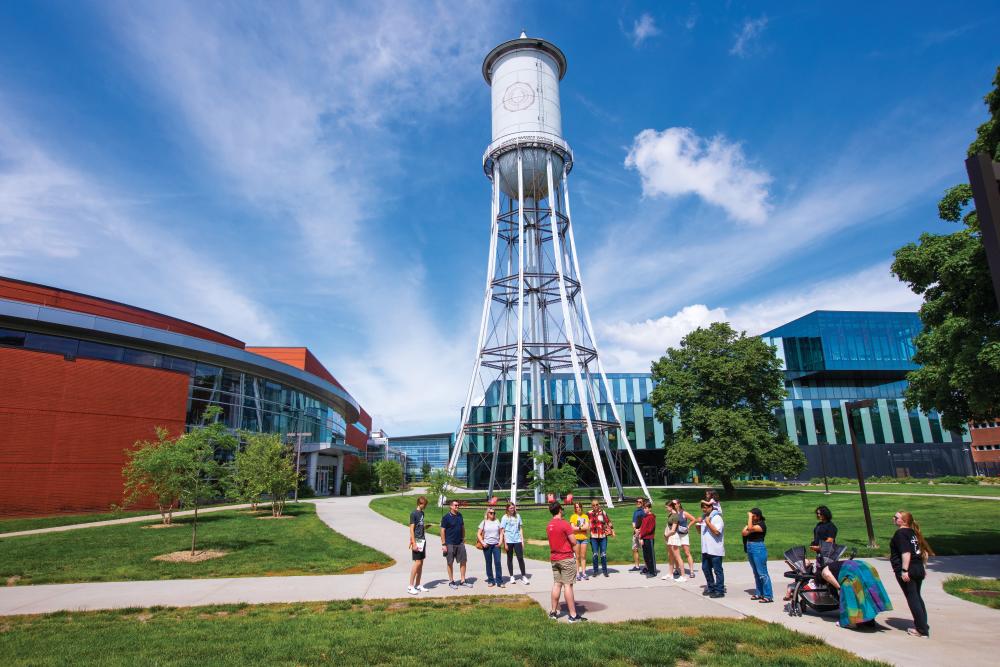
Iowa State University (ISU) has been a pioneer since its founding as the first coeducational land-grant school. Located in Ames, Iowa, the university continues to propel its educational offerings through resources, programs and pathways.
“A number of institutions across the United States were founded as land-grant institutions with the goal that they would bring amazing educational opportunities to constituents in their states and that the learning opportunities would benefit their communities,” says Abram Anders, the Jonathan Wickert Professor of Innovation and associate director of the Student Innovation Center at ISU.
In This Article
Iowa State’s Student Innovation Center
“The Student Innovation Center is really emblematic of Iowa State’s land-grant mission,” Anders says.
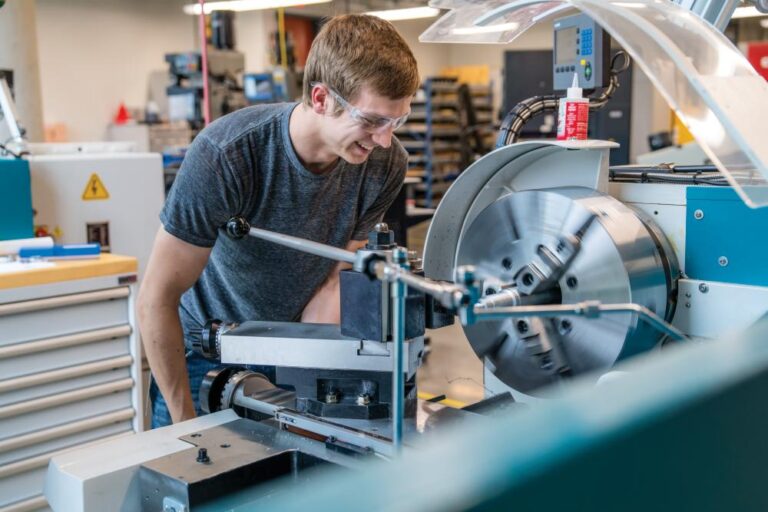
The 140,000-square-foot center, which includes makerspaces for 3D printing, glass blowing, podcasting and more, is open to all ISU students, faculty and staff.

“That makes it really unique,” Anders says. “At a lot of schools, these resources are held within individual colleges for specific majors. We can have all students from all majors working together on an innovation project – that can be a great benefit not only to their ability to build skills, but also to their curricular experiences.”
Recent innovative projects completed by the ISU students include a handmade acoustic guitar, a nixie tube clock and a brand-new instrument crafted from thrifted bicycle parts.
“Employers tell us they wish candidates had more creative problem-solving skills and experiences working in interdisciplinary teams,” Anders says. “The kind of programming we’re offering is part of that puzzle. We give students a chance to take the cutting-edge skills they develop in their majors, and then do something that’s a little bit outside the box with peers from other disciplines.”
Degree Programs and Minors
ISU’s College of Liberal Arts and Sciences recently added two new degree programs and three new minors. These programs include a master of applied statistics, a bachelor of arts in sports media and communication, and Spanish translation and interpretation, applied AI, and applied mathematics minors.
These new pathways aim to meet emerging demands from employers as well as new interests of incoming students.
Food Science Certification
In 2024, the University’s Culinary Food Science program received formal recognition as an approved Research Chefs Association (RCA) Culinology program.
RCA is a leader in food research and development. Culinology, an RCA term, refers to the partnership between culinary arts and food science to create delicious, safe and sustainable food products.

“We are very excited that our students will have the opportunity to be part of our RCA-certified Culinary Food Science program,” says Lorraine Lanningham-Foster, chair of the Department of Food Science and Human Nutrition.
“The approval will help connect our students to more opportunities for professional development and scholarships.”
Innovation Lab
Also in 2024, the university opened the Digital Agriculture Innovation Lab, which was established by ISU Research Park, a growing technology community and incubator, in partnership with utility company Alliant Energy.

The more than 85,000-square-foot center provides students with space to take part in hands-on learning experiences as well as educate farmers on ways to implement technology to increase real farm value.
Overall, the lab works to develop technologies and products, such as smart sensors and control systems and biomass logistics, aimed at improving agriculture.
AI Tutor
Karl Kerns, assistant professor of animal science, and Tom Brumm, professor of agricultural and biosystems engineering, recently devised an AI tutor to better support their students.
“In an effort to make sure that we have tutoring available to everyone, regardless of socioeconomic situations, we wanted to build this AI tutor,” Kerns says.
The AI avatar-based system can be fully trained on specific coursework. Students can customize the avatar, choosing from skin color, gender, language and dialect.

Not only will the tutor go over lessons, tailor study sessions based on students’ needs and quiz students, but it will also provide real-time feedback to the course instructors.
“We have it designed to send an email Monday morning showing what students are understanding and what they aren’t understanding,” Kerns says. “I think it’s going to transform the way we can teach.”
Mission Moon: Traveling Space Camp Rolls Through Iowa
Sara Nelson, director of the NASA Iowa Space Grant Consortium and Iowa NASA EPSCoR, once worked at the Science Center of Iowa in Des Moines and recalls the Challenger Learning Center, a NASA exhibit that featured space simulations.
“It really impacted me,” Nelson says. “Everyone who came into it was highly engaged and learned a ton. When there was a chance to propose something, all I kept thinking about was how impactful that was on my learning.”
Wanting to bring that experience to youth all around the state, Nelson, along with multiple partners, submitted a proposal for “Launchpad to Tomorrow: Expanding STEM Access for Youth Through Catalyst Mission-Ready Space Camps,” which was selected to receive support through the Iowa State University Extension and Outreach Catalyst Program.
Partners include the Ericson Public Library, Collins Aerospace and the Iowa Children’s Museum, among several others.

Experiences & Adventures
6 Fun Things to Do in Ames, Iowa, After Work
There’s always an adventure to be had in the region.
The goals are to make space learning more accessible, inspire youth to consider a career in the space industry and provide students with an activity that develops teamwork and communication skills.
The pilot of Mission Moon, an exhibit that includes a portable planetarium, museum with NASA artifacts, drone work, and, of course, the mission, launches in the summer of 2025.
“You train like an astronaut and create your mission patch,” Nelson says. “And then you get your mission, and you have all these tasks to do. When you come back, you have a simulated press conference where you talk about what you did.”
By traveling to different communities, the space camp can reach students who don’t have quick access to a science museum and wouldn’t otherwise have this type of experience.
“The more chances we give youth to try new things that require teamwork and collaboration and innovation, the more they will be ready for whatever they decide to do in the future,” Nelson says.
Get to Know Ames
Want to learn more about living and working in Ames, IA? Check out the latest edition of Livability Ames, Iowa, And The Greater Boone, Hamilton & Story County Region.