
Pre-Apprenticeship Programs Prepare Students for Careers in the Triangle East Region of North Carolina
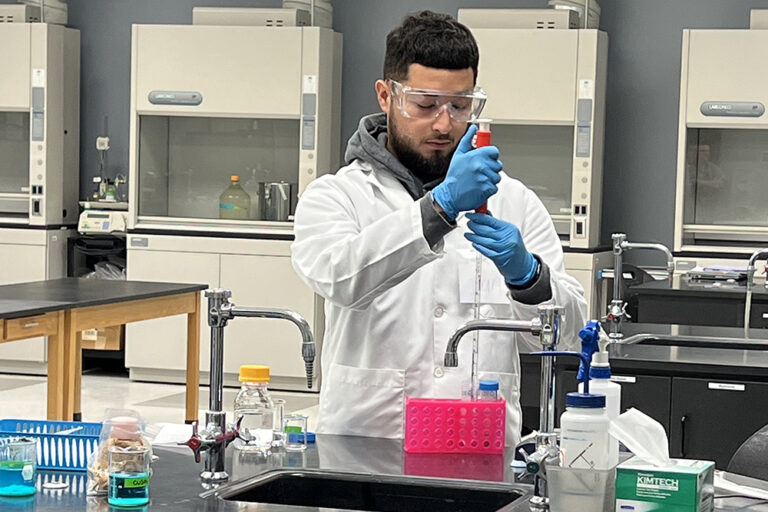
In the Triangle East, high school isn’t just textbooks and tests – it can be a gateway to real-world opportunities and promising careers. Through a partnership between Johnston County Public Schools (JCPS), Johnston Community College (JCC) and industry leaders, pre-apprenticeship programs are transforming students into skilled professionals while addressing critical workforce needs.
A Strong Foundation
Career and Technical Education (CTE) programs are the backbone of the region’s workforce development efforts, equipping students with technical know-how as well as critical employable skills.
“In addition to specific technical skills, students learn durable skills – such as adaptability, collaboration, communication, critical thinking, empathy, learner’s mindset and personal responsibility,” says Reno Palombit, director of career and technical education. “Our goal is for every graduate to have a plan for their future and the skills, knowledge and aptitudes to make it a reality.”
The school district offers CTE programs in more than three dozen career paths – from accounting and agriculture mechanics to sports marketing and travel and tourism. Students also participate in industry tours, job shadowing, internships and apprenticeships, which connect them to local employers and real-world experiences.
A Head Start to a Promising Career
JCPS builds on its CTE programs by partnering with Johnston Community College and local employers to give high school juniors and seniors on-the-job training through pre-apprenticeships. These programs create a bridge between education and employment, setting students up for success and maintaining a steady pipeline of talent to growing industries.
“Pre-apprenticeship programs provide early training for high school students through related instruction specifically aligned to an occupation, thus filling employment gaps and meeting the demand of local employers,” Palombit says. “These programs allow for unique networking experiences between the students and the pre-apprenticeship partners that can lead to further training and employment with local employers and help students refine skills that will build a strong future workforce.”
The BioWork pre-apprenticeship program introduces students to the region’s growing biomanufacturing industry. Participants spend the summer working at a local company and learn about pharmaceutical production, quality control and other in-demand life sciences skills. By the time they graduate, students are prepared to step into high-tech roles or continue their education in related fields.
Students enrolled in the Caterpillar pre-apprenticeship program begin with two classes in their junior year – safety and hydraulics – then spend their summer working 32 to 40 hours a week at Caterpillar. During their senior year, they balance additional classes like blueprint reading and maintenance with part-time work at Caterpillar. By the time they graduate high school, they’ve earned a certificate with 12 college credits, which can be applied toward JCC’s Applied Engineering program.
“We teach them technical skills they wouldn’t get in high school – things like hydraulics, pneumatics and blueprint reading. Plus, they earn their OSHA 10 safety certification, which is invaluable,” says Maxie Kirby, department chair, Transportation and Advanced Technologies, at JCC. “It’s a seamless pathway. Students gain hands-on experience, a nationally recognized credential, and real-world skills that set them apart.”
Good for Business
Both Palombit and Kirby agree that these programs go beyond technical training to develop well-rounded professionals.
“These students are working alongside seasoned employees, so they need to know how to interact and collaborate effectively,” Kirby says. “It’s about more than just knowing how to fix something – it’s about knowing how to work as part of a team.”
For companies, such as Caterpillar, Maxie says the pre-apprenticeships serve as a “long job interview,” allowing them to identify and train promising talent.
“Caterpillar sees this as an investment. They can vet students without making a major financial commitment upfront. And for students, it’s a chance to prove themselves and potentially secure long-term employment with a globally recognized company,” he says.
Palombit says the pre-apprenticeship program is a win-win for the entire community. The programs are structured to be affordable for families, with pre-apprentices earning while they learn. Additionally, JCC students can take advantage of the North Carolina Career and College Promise program, which covers tuition for qualifying students.
“If we want to build the future workforce, we cannot work in silos,” Palombit says. “The partnership between JCPS, JCC and local employers is a model for how collaboration can create meaningful opportunities for students and meet the needs of our region.”
Get to Know the Triangle East
Want to learn more about living and working in Smithfield, Selma and the Triangle East region? Check out the latest edition of Livability Triangle East, North Carolina.