
Excellent Assets Fuel Manufacturing in Dayton Region
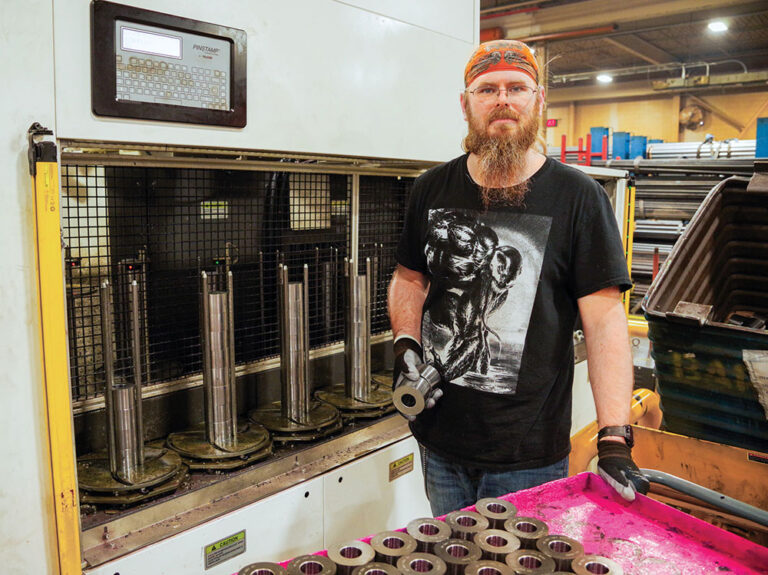
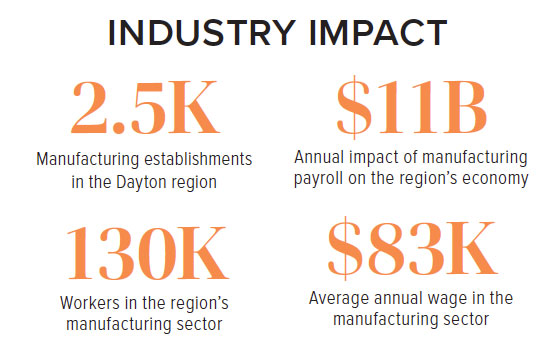
There’s a reason it’s not unusual to hear the expression “made in Dayton.” Actually, there are more than 130,000 reasons. That’s the number of people employed by the nearly 2,500 companies involved in manufacturing in Dayton and the surrounding communities.
Those employees comprise nearly 15% of the workforce and make $83,000 per year on average. Overall, the manufacturing payroll pumps nearly $11 billion annually into the economy, says Angelia Erbaugh, president of the Dayton Region Manufacturers Association.
“This is a great place for manufacturers to set up their business,” Erbaugh says.
In This Article
Why Is Manufacturing in Dayton Succeeding?
The region’s hard-to-match assets include its location close to major markets, transportation infrastructure, low cost of doing business and workforce development initiatives. To that list Erbaugh adds support for entrepreneurs as well as a collaborative environment, where someone with a question can always find someone with an answer.
Manufacturers doing business in the area include major employers like Honda, AK Steel and Copeland (formerly Emerson Climate Technologies).
Another regional success story is Spintech Holdings, which works with the aerospace and defense industries.
“Members of the Dayton Region Manufacturers Association make critical connections with other people and companies and share challenges, best practices and solutions. They work collectively to solve problems,” Erbaugh says.
Valuable Resources
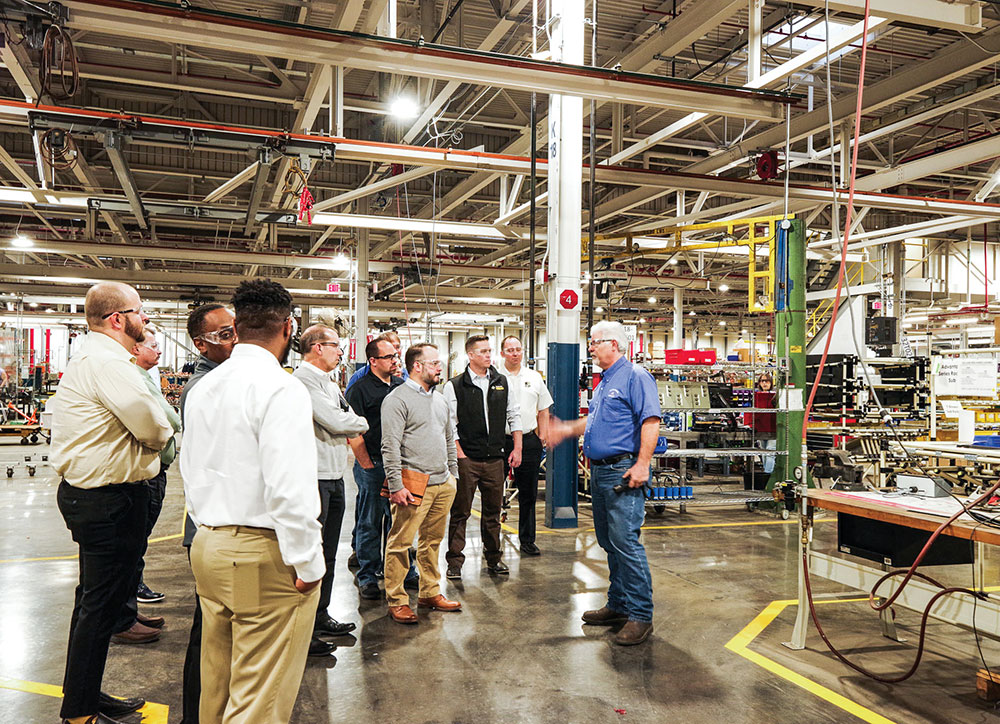
Manufacturers in Dayton and the region can call on several resources, including FastLane. The nonprofit organization is a program of the University of Dayton Research Institute. Services offered by FastLane include advanced manufacturing support, workforce development, continuous improvement advice, engineering expertise and other solutions that are helpful for growing businesses.
FastLane is the west central Ohio Manufacturing Extension Partnership center. MEP is a national network created by the National Institute of Standards and Technology to help small and medium-sized manufacturers become more innovative to drive growth and create jobs.
“The Dayton region has a rich history in manufacturing. Both I-70 and I-75 cross our region, making us one of the most accessible cities in the U.S. Shipments can reach more than 60% of the U.S. in less than one day from Dayton. Because of the number of manufacturers here, we have many educational facilities that support building the skilled workforce that is needed for these companies,” says Phil Ratermann, FastLane’s director.
“We also have an established network of local manufacturing support, and our manufacturers collaborate with one another whenever possible. Dayton is affordable and a safe place to raise a family with a reasonable cost of living and great people. This is why we are seeing a lot of growth in large manufacturing projects,” he says.
Manufacturing clients are telling FastLane that 2023 was an exceptionally busy year for catching up on backlogs that resulted from higher-than-normal demand. Many of the companies, having experienced significant production issues due to supply chain woes as the pandemic ended, increased their inventory and safety-stock levels to prevent a reoccurrence.
Right-Sized Solutions
“For most industry sectors, there is guarded optimism for 2024. As always, the workforce question remains the No. 1 topic of our conversations with clients.
We strive to understand the specific challenges they face in their business today, then offer a right-sized solution,” Ratermann says.
Those solutions look like upskilling current staff, improving processes through Lean Continuous Improvement projects, implementing new technology automation where appropriate, improving recruiting and retention practices, and utilizing product engineering services.
Unlike manufacturing centers whose economies depend on one or two large employers, Dayton is home to a large number of small manufacturers.
“We’re highly diversified. Many companies work with other manufacturers in the supply chain. Those companies serve manufacturing customers in diverse markets as opposed to other manufacturing clusters that are focused on a particular product,” Erbaugh says. “So, if one industry slows down, the other markets might speed up.”
That diversity is reflected by the 200 manufacturers and the 130 suppliers and other enterprises that are members of the Dayton Region Manufacturers Association. “We’re a one-stop shop,” Erbaugh says of Dayton, meaning going from concept to production is a seamless process in the Dayton region.
In an ever-changing economy, Dayton’s diversified approach and collaborative spirit offer a model for sustainable growth and prosperity in the manufacturing sector.

Monumental Ideas
Dayton residents have a history of inventing products that are now commonplace for consumers in America and beyond. For example, Dr. William Hale Charch was a chemist at DuPont Co., where he invented cellophane. Vincent Apple is credited with bringing electricity to rural homes. E.R. Churchwell developed the first collapsible baby crib, and Frigidaire employee Arthur Frei pioneered a quick-release lever on top of metal ice cube trays that dislodged the cubes.
To commemorate many of the products created in Dayton, the Dayton Inventors River Walk in RiverScape MetroPark features several oversized sculptures called Invention Stations that recognize achievements by local innovators. That’s where visitors can find a station devoted to the ice cube tray, which is next to another station, detailing how the cash register got its start in Dayton in 1884.
Another stop features the pop-top aluminum can, invented by Ermal Fraze, who owned Dayton Reliable Tool & Manufacturing Co. Fraze attended a picnic in the 1950s and wanted a beer but forgot his can opener, so he used the bumper of his car to open the beer and then vowed to develop an easy-opening can – and he did.
While walking between Invention Stations, don’t forget to look down, where over 150 brick tiles honor even more inventions that started in the region, such as the digital watch, recycled newsprint, Freon, barcode scanners, ATMs and the cracking of the German’s Enigma Code in World War II.
– Kevin Litwin contributed to this article.
Get to Know Dayton
Want to learn more about living and working in Dayton, OH? Check out the latest edition of Livability Dayton, Ohio.