
The Ultimate Guide to Flying With Pets

Let’s face it: Traveling with a pet is one thing, but flying with a pet is a whole new ball game. The question is, where do I even get started? How do I know if my pet qualifies for this certain airline? Which airline allows my pet guinea pig (yes, this is a thing!)? Luckily, we have done all the research for you, and hopefully, through this guide to flying with pets, you can feel confident about bringing your furry (or feathered) companion on any adventure that lies ahead.
In This Article
Pet Travel Is on the Rise
Over the past decade, pet travel has increased significantly, with the National Institutes of Health (NIH)’s Center of Biotechnology Information estimating that 2 million domestic animals travel on commercial flights annually in the U.S. alone — that’s around 6% of pets in the U.S. boarding a plane each year. Furthermore, dogs constitute 58% of pets traveling worldwide, highlighting the growth of pet travel.
Before flying, most pet owners take several steps to prepare their animals. According to that same owner-reported survey study from the NIH:
- 67.4% of participants crate-trained their dogs before air travel
- 74.8% visited a veterinarian for a physical examination
- 79.2% ensured their pets received required vaccinations, blood tests, microchip placement or parasite treatments
Despite these precautions, stress remains a concern for pet owners. The study found that:
- 70.1% of dogs showed signs of stress during their handover before the flight
- 72.4% of dogs showed signs of stress during the flight
- 32% of dogs showed signs of stress upon arrival
Ahead, we explore all the ins and outs of flying with your pet, from what pets are allowed to fly, to weight limits, documentation, and the cost of flying with your pet. Plus, we offer tips for a stress-free flight, ensuring your getaway is as relaxing for your pet as it is for you!

What Pets Are Allowed To Fly?
While cats and dogs are the most common pets to travel by air, several airlines allow other domesticated animals to accompany their owners, including birds, rabbits, ferrets and guinea pigs. However, each airline has different policies and permitted animals.
To highlight a few of these differences, we’ve compiled the pet policy information for the most popular domestic airlines. It is important to note that while some animals may fly in the cabin, others must be transported via cargo:
- American Airlines typically permits small birds, dogs, cats and other small domesticated animals, which may be considered on a case-by-case basis. American Airlines utilizes a Priority Parcel Service, and more in-depth regulations can be found here.
- Alaska Airlines allows dogs, cats and small birds, rabbits, guinea pigs and hamsters to travel in the cabin, each with their own guidelines. Alaska allows pets up to 150 pounds to travel in their climate-controlled baggage and cargo compartments.
- Delta Airlines allows small dogs and cats, as well as small birds, hamsters, and rabbits in the cabin on certain domestic flights, and offers checked baggage options for other animals. While these pets may travel internationally, Delta cannot accept warm-blooded animals on flights longer than 12 hours. Delta does not participate in the Neighbor Island Dog and Cat Entry Program.
- Allegiant Airlines welcomes small pets into the cabin on domestic flights within the contiguous United States, but it is limited to dogs and cats. Travel to international destinations and U.S. territories, including flights to Alaska and Hawaii, does not permit pets. Allegiant does not transport animals in the cargo bin.
- Southwest Airlines permits small, vaccinated dogs and cats in the cabin on domestic flights. Southwest does not allow pets on flights from Hawaii (unless traveling between islands) or international itineraries, except for service animals. Additionally, Southwest doesn’t accept pets as cargo or checked baggage or allow any other types of pets to travel in the cabin.
- Frontier Airlines allows dogs, cats, rabbits, guinea pigs, hamsters and small household birds in proper carriers in the cabin on domestic flights and does not allow pets to be checked as baggage. Domesticated dogs and cats are welcome on international flights.
- United Airlines permits household birds to travel in the cabin on domestic flights, depending on the animal’s size. Animals must be at least eight weeks old and able to comfortably fit in a carrier for the flight’s duration. United does not allow pets to fly to, from or through a list of states and countries that can be found here.
- Spirit Airlines allows small pets, including dogs, cats, household birds and rabbits, on all domestic flights, including select territories. Spirit does not accept animals on international flights, except for service animals.
It is important to check your airline’s policies before booking your trip to ensure your pet is within the guidelines. Most offer a robust overview of their specific policies and recommendations, particularly for international travel.

Weight Limits and Crate Requirements: Carry-On vs. Cargo
In general, carry-on pets must meet strict size and weight requirements, while pets traveling in cargo have more flexibility. Based on the airline, this can vary significantly; however, a general guideline would be:
Carry-On Pets
- Weight limit: The combined weight of the pet and carrier must be between 15 and 20 pounds.
- Carrier size: The carrier must fit under the seat in front of you and must be no more than 18x11x11 inches.
- Pets allowed: With the weight limits typically running 15-20 pounds, including the carrier, small dogs, cats and other animals like birds or rabbits are allowed as a carry-on in the cabin. It is also worth noting that airlines often limit the number of pets allowed in the cabin per flight.
Cargo Pets
- Weight limit: Typically, there is no strict weight limit for pets traveling in the cargo hold, but some airlines have maximum weight limits of around 100 pounds for the pet and crate combined. However, some airlines offer higher weight limits, up to 150 pounds.
- Crate requirements: The crate must be sturdy, well-ventilated and large enough for the pet to stand, turn around and lie down comfortably.
- Pets allowed: Larger dogs, cats, and other animals like rabbits, birds and even some exotic animals may be permitted to travel in cargo.

How Much Does It Cost To Fly With a Pet?
The cost of flying with a pet can add up quickly. Here is a quick breakdown of pet fees for major U.S. airlines:
American Airlines
- Carry-On: $150/carrier each way
- Cargo: cost varies for storing your pet in cargo across different regions and locations
- Service animals: fly free to all destinations
Alaska Airlines
- Carry-On: $100/carrier each way, subject to space availability onboard
- Cargo: $150/kennel each way
- Service animals: fly free to all destinations
Delta Airlines
- Carry-On: $125/carrier each way for North American destinations, $200/kennel each way internationally, $75/kennel each way to Brazil
- Cargo: costs vary for storing your pets in cargo across different regions and locations but typically range from $200 to $600 per pet
- Service animals: fly free to all destinations
Allegiant Airlines
- Carry-On: $50/carrier each way
- Cargo: N/A
- Service animals: fly free to all destinations
Southwest Airlines
- Carry-On: $125/carrier each way on mainland flights, $35/carrier each way between Hawaiian islands
- Cargo: N/A
- Service animals: fly free to all destinations
Frontier Airlines
- Carry-On: $99/carrier each way
- Cargo: N/A
- Service animals: fly free to all destinations
United Airlines
- Carry-On: $150/carrier each way; there is an additional $125 fee per pet for each layover of more than 4 hours within the U.S. and more than 24 hours internationally
- Cargo: N/A
- Service Animals: fly free to all destinations
Spirit Airlines
- Carry-On: $110/carrier each way
- Cargo: N/A
- Service animals: fly free to all destinations

‘Dogs Fly First’ With BARK Air
Traveling with a pet can seem daunting, and while most airlines are becoming more pet-friendly, new alternatives are emerging. BARK Air, which took flight in May 2024, is a new dog-friendly airline. The airline takes a white-glove approach to air travel, providing pets (and their people!) with a first-class experience. Once a flight is booked, the BARK Air concierge will reach out to collect information about each dog to ensure the best possible experience. On travel day, arrive at the airport 60 minutes before takeoff for a simple check-in process to complete a security screening and meet the other furry friends taking your flight. No crates, no lines!
Before boarding, a concierge team member will greet the dogs at the gate and help them through dog-centric cabin preparation. Also, the plane is given the “Dogs Fly First” treatment, with calming pheromones, music and colors that pups prefer. All guests also have access to in-flight aids like calming treats, noise-canceling ear muffs and calming jackets.
Once everyone is on board, dogs are served a snack or beverage of their choice during takeoff and landing so they don’t experience any ear discomfort caused by changes in cabin pressure.
How much does BARK Air cost? BARK Air currently routes through New York City, Los Angeles, London and Paris with tickets ranging from $6,000 to $8,000 per ticket. However, the airline is hoping to expand in the future.
Charter Flights Expand Options for Flying With Pets
Other alternatives for flying with a dog include flying private — which isn’t exactly accessible to most. However, some new options make this dream a reality for pet owners.
JSX is a public charter jet service offering semi-private air travel between the U.S. and Mexico. JSX’s pet policy permits cats and small dogs on board for a fee of $100 per kennel per flight. Small pets must fit comfortably in an approved carrier stowed underneath the seat for the duration of the flight. Additionally, JSX permits medium-to-large dogs to be transported in the cabin. For dogs that are too large to occupy the approved under-seat pet carrier (13″ x 11″ 17″), customers are required to purchase an adjoining seat where the dog is permitted to lie on the floor directly in front of the seat. Medium to large pets flying in the cabin must be leashed at all times, weigh 79 pounds or less and be well-behaved.
Services like K9 Jets and Air Charter Service can help coordinate flights and file paperwork for flying with pets privately. Additional private plane options like Wheels Up, BLADE and PrivateFly also allow pets to be on board.
Finally, take to social media. A dedicated Facebook group called Chartered Air Travel with Pets connects people traveling to the same destination and looking to fly without putting their pets into cargo. Members can connect and see if their flights align and group up to reduce the costs of chartering a private flight.
Health and Documentation Requirements for Flying With Pets
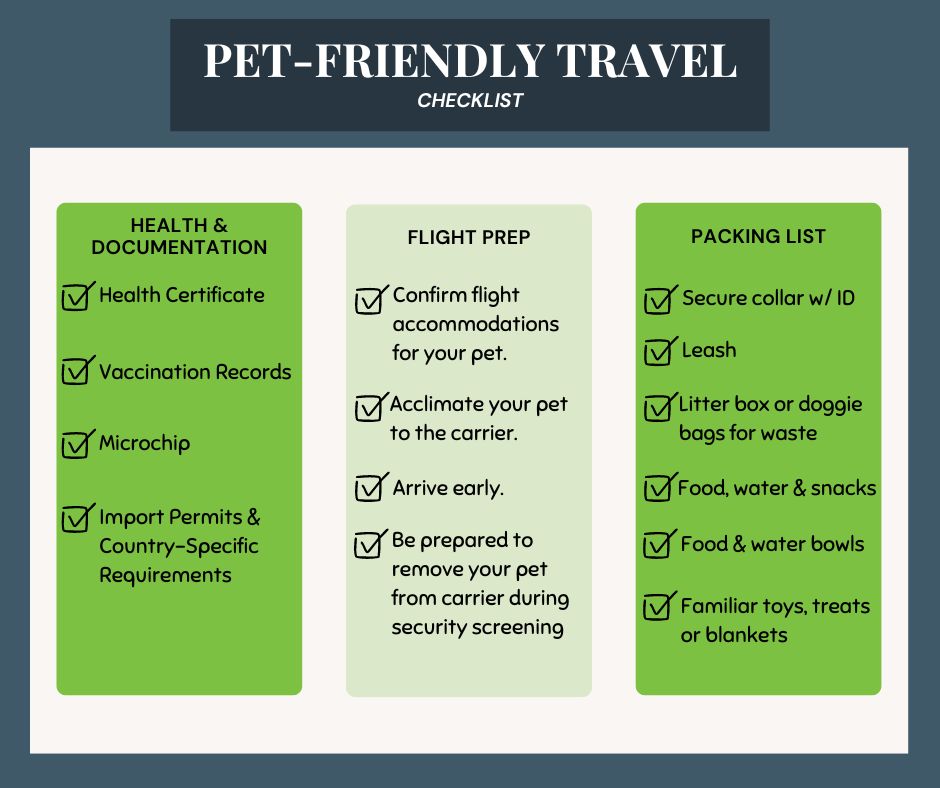
Preparation is key when traveling with your furry companion, particularly regarding health and documentation. For airlines and even some destinations, pet owners must meet specific requirements for their pets. Here is a complete checklist to make sure you feel prepared!
1. Health Certificate: A health certificate is a document issued by a licensed veterinarian that confirms your pet is well enough to travel. For domestic flights, it must be issued within 10 days of travel. Internationally, the timing can vary, often requiring issuing within 10 days to a month before departure. This certificate will include vaccination status, overall health and confirmation that your pet is free from contagious diseases.
2. Vaccination Records: Typically, standard vaccinations include rabies, distemper and parvovirus for dogs and rabies and feline viral rhinotracheitis, calicivirus and panleukopenia for cats. Some countries require vaccinations like the rabies shot to be administered at least 21 days before traveling. Additional vaccinations may be necessary, depending on the destination.
3. Microchip: Some countries require pets to be microchipped for identification purposes. The microchip number should be listed on the health certificate and vaccination record. Some countries that require a microchip include the British Virgin Islands, the United Kingdom, Australia, China, France, Germany and more. For a complete list of countries requiring microchips for entry, click here.
4. Import Permits and Country-Specific Requirements: A few countries require an important permit, typically obtained from the destination country’s agriculture or animal control department before travel. Additionally, some countries require pet quarantine upon arrival, blood testing or proof of recent treatments for ticks or tapeworms.
Preparing Your Pet for Takeoff
Phew, you’ve finally made it through the red tape, and now it’s time to take flight. For a seamless traveling day for both you and your pet, here are a few ways to prepare for your flight.
1. If possible, keep your pet in the cabin with you. The cargo of a plane can be very traumatic for an animal. Figure out what airline allows you to carry on your pet to reduce the chances of separation anxiety.
2. Chat with your veterinarian for some specific guidance. If you know your pet is a little anxious or tends to be on the more high-strung end, see if your vet can prescribe anxiety medication that you can give to your pet before the flight. If you do not want to give your pet medication, try out an anxiety vest to help calm your companion.
3. Bring a comfort item with you. Anything that feels safe to your pet, like a blanket or plush toy, can be that sense of comfort that a pet needs to feel just a little bit safer. Extra points if it smells like home, too!
4. Preflight workout! Give your pet a preflight workout by throwing the ball, going on a walk or maybe a run to calm their nerves and tucker them out. Being mindful of your own stress levels and theirs can also go a long way. Have mental check-ins with yourself, stay hydrated and give yourself plenty of time in the airport.
Check out some additional tips here.
Some other tips and tricks that might be helpful are:
- Confirm flight accommodations for your pet.
- Acclimate your pet to the carrier.
- Feed your pet before takeoff and take a few potty breaks; most airports have pet relief areas now, too!
- Arrive early.
- Be prepared to remove your pet from its carrier during security screening.