
Women Leaders Help Sculpt Muskegon’s Arts Scene
“One Drop,” a 27-foot steel sculpture of a single water drop, stands tall outside the VanDyk Mortgage Convention Center in Muskegon, with LED lights glowing from dusk until dawn. The sculpture, erected as part of the Muskegon City Public Art Initiative (MCPAI), was commissioned by the Women’s Division Chamber of Commerce to commemorate its 70th anniversary.
“This concept was immediately the obvious one, the idea of one drop symbolizing that a single action can have a big impact, which is what the Women’s Division believes in,” says Judith Hayner, MCPAI project manager. “And when they come together, they have a big impact on what happens in the community.”
This symbol is very fitting for the Muskegon Lakeshore – a region that supports women in the arts, and in which women in the arts uplift each other. “As a woman, I have never felt held back in Muskegon,” says Hayner, the former executive director of the Muskegon Museum of Art.
Women Supporting Women
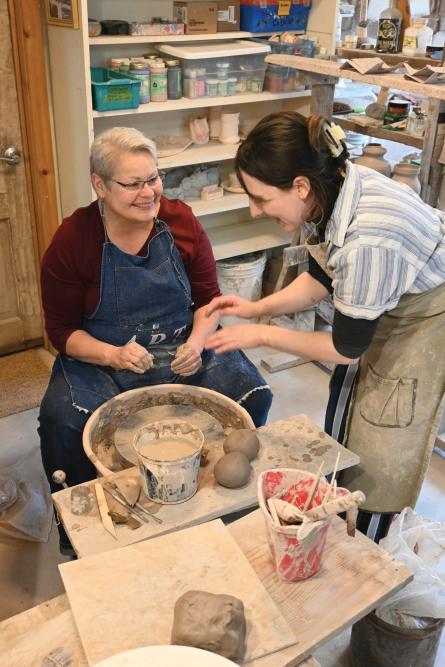
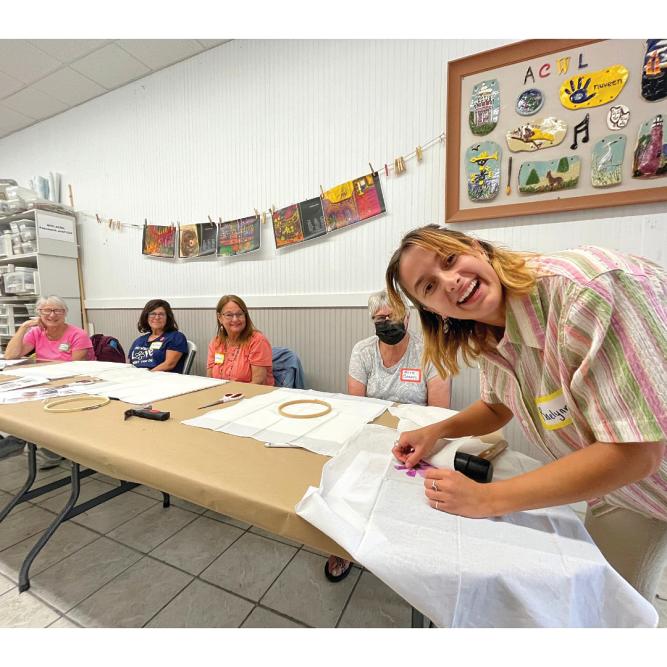
Erin Peyer, director at the Arts Council of White Lake (ACWL) – Nuveen Center, started her career in the arts nonprofit sector when she moved to the area in 2018. “When I first started here, Cathy Mott (assistant director of the Muskegon Museum of Art), whom I had never met, contacted me and said, ‘Let’s get together and have coffee. I’m here as a resource.’” Mott previously held the director role at ACWL – Nuveen before being hired by Hayner to work at the Muskegon Museum of Art.
“I want to be that person who helps the person standing beside me to be able to do better,” Mott says. “That means giving of yourself, giving of your expertise and your time. That’s what Judy Hayner taught me. I get to play that on to the next generation. For women especially, we’re very cognizant of the fact that we’re better as a team.”
Hayner recalls a time when the majority of arts and cultural institutions in the Muskegon Lakeshore area were led by women. “There was quite a cadre of women, but we all started retiring at the same time,” she says. “I’ve been talking with Cathy Mott about how we can help the women today who are out there doing the work in these leadership positions, or in positions that will lead to leadership.”
Together, they created the Women’s No Work Network. “In other words, no committees, no bylaws, no fundraising – none of it,” Hayner says. “It’s just going to bring women together to get to know each other.” Mott notes the turnout for their first networking session was substantial. “This community has definitely built some amazing women leaders, and I give that credit to the generation before,” Mott says.
Adding Arts Representation
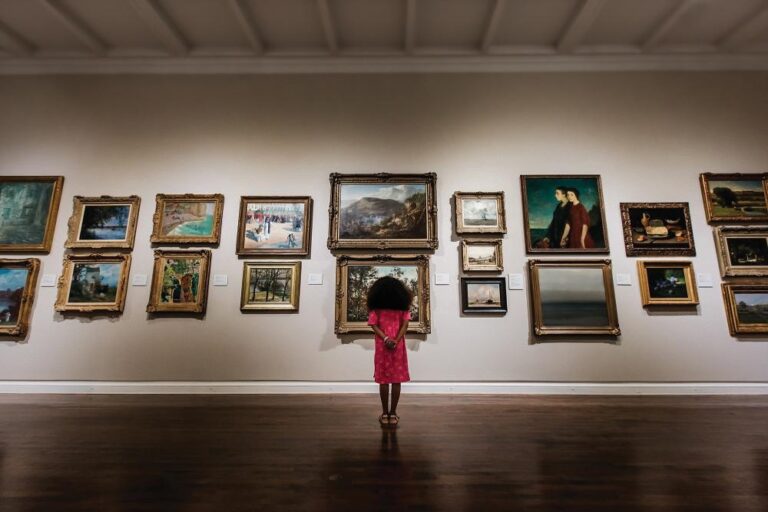
According to a 2019 article in Artnet News, just 11% of all acquisitions and 14% of exhibitions at 26 prominent U.S. museums over the previous decade were of work by female artists. And a data analysis of 18 major U.S. art museums found their collections were 87% male and 85% white. “We are working to make sure our galleries are not 87% male and 85% white, because that’s not who we are. And that’s not what our community looks like either,” Mott says.
This work has been ongoing, as the museum began collecting African American art in the ’90s. And with a recent gift from art collectors Steven Alan Bennett and Dr. Elaine Melotti Schmidt, Muskegon will soon be home to one of the only museums in the world with a permanent space dedicated solely to the work of women artists.
The gift, valued at $12 million, includes more than 150 works created by women in the figurative realist style from Bennett and Schmidt’s collection, as well as a $1.5 million cash gift toward museum expansion. “The museum has become much more dedicated to exposure, diversity and inclusion, and thinking about what that looks like,” Mott says. “With the expansion, we get to make an even greater impact.”
Camp Provides Early Start to the Arts
One of the highest-ranked fine arts camps in the U.S. takes place in Twin Lake every year.
The annual Blue Lake Fine Arts Camp was founded in 1966 and continues each summer at a 1,600-acre campus within the Manistee National Forest on the shores of Little Blue Lake. Up to 4,500 students in grades 5-12 attend programs in music, art, dance and drama over 12-day sessions, and many camp attendees are international exchange students.

There is also the offshoot Bernstein Camp for students, who can choose between orchestra and band for their concentration during their 12 days. All campers at Blue Lake have access to rustic facility buildings, shelters and cabins within the beautiful wilderness setting.
“Our camp serves thousands of students by providing diverse programs, and part of Blue Lake’s philosophy is ensuring that the fine arts are available to all,” says Heidi Stansell, vice president of operations at Blue Lake. “All programs accept participants on a first-come, first-served basis.”
Blue Lake is a nonprofit with 26 full-time employees, 600 seasonal workers and a total payroll of $3 million. The organization generates more than $250,000 annually in total taxes (state, property, hotel, etc.) for the Muskegon Lakeshore region.
Stansell adds that a key mission at Blue Lake is to provide an environment that encourages creativity and recognizes the importance of the individual student.
“While 72% of our campers come from Michigan, over the past five years we have hosted campers from 38 different states and 12 countries,” Stansell says. “In 2022, we also employed counselors, faculty and support from 40 states and six countries.”
For more information, visit bluelake.org.
– Kevin Litwin contributed to this article.
Get to Know the Muskegon Lakeshore
Learn more ways to have tons of fun along the Muskegon Lakeshore at Livability Muskegon Lakeshore.