
New Mexico Leading the Way on Renewable Energy
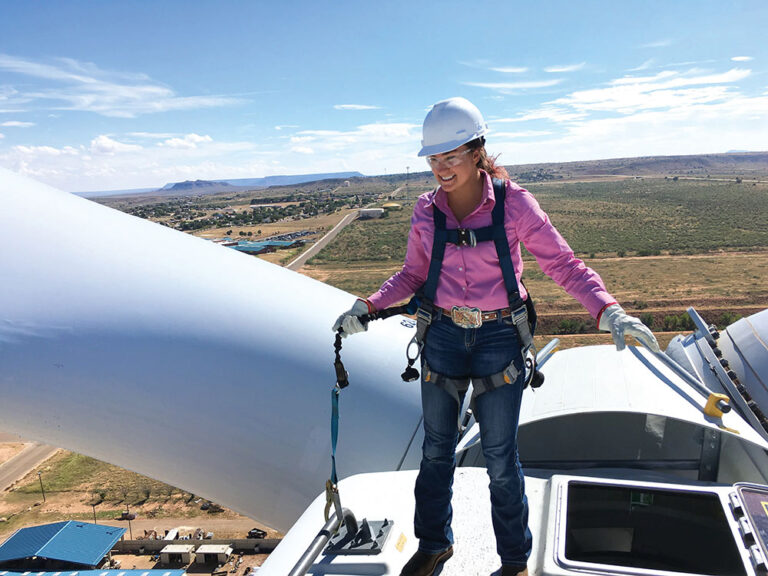
The move to green energy in New Mexico is a win-win for the environment and the economy. These projects will allow New Mexico to harness its abundant sun, wind and geothermal resources.
“Our large expanses of sun-drenched, wind-blown land are a huge plus,” says Andrew Swapp, director of renewable and sustainable technology at Mesalands Community College. “The high desert is ideal to optimize solar efficiency, and the wind corridors are showing long durations of time where power production is optimal.”
In This Article
Career Opportunities for Green Energy in New Mexico
For residents across the state, and especially students at Mesalands’ North American Wind Research and Training Center in Tucumcari, this means promising career opportunities. The Energy Transition Act is driving this forward momentum, says Joshua McVey, vice president of student affairs at Mesalands.
“It puts New Mexico on the path to lead the way in renewable technology, future-proofing lucrative careers in one of the fastest-growing industries in the nation,” he says.
While barriers remain, New Mexico is well-positioned to work with green energy innovators.

Largest Ever Renewable Project
Many renewable energy companies worldwide are investing in New Mexico, such as Array Technologies and Maxeon Solar Technologies of Singapore as well as Australia’s Star Scientific. Setting a new standard for renewable energy infrastructure, U.S.-based Pattern Energy is developing the landmark SunZia Wind and Transmission project.
“Together, the SunZia Wind and Transmission is the largest renewable energy infrastructure project in U.S. history and will provide clean power for 3 million Americans,” says Jeremy Turner, director of New Mexico project development at Pattern Energy.
SunZia Wind sprawls across 528,000 acres in Lincoln, Torrance and San Miguel counties for a total 3,515 megawatts of wind energy. SunZia Transmission provides a 550-mile, 525-kilovolt direct current transmission line to the southern Arizona region.
Renewable energy transmission remains a major hurdle for decarbonization in the U.S., but SunZia is providing a blueprint, while boosting the local economy.
“A study found the project will produce total economic benefits of $20.5 billion,” Turner says. “We are excited to be well underway on building this historic project, creating over 2,000 jobs during construction and supporting over 100 permanent jobs once it reaches operation.”

H20 Innovation
New Mexico has no shortage of energy innovators. Sandia National Laboratories and Los Alamos National Laboratory conduct research on renewable energy. Beyond Mesalands, other colleges and universities, including the University of New Mexico’s Center for Emerging Energy Technologies and Renewable Energy and Thermal Systems Laboratory, strive to enhance sustainable solutions.
Water, of all things, makes this electricity research and production possible. That’s why Gov. Michelle Lujan Grisham announced a strategic water supply to bolster clean energy projects and mitigate drought effects.
“A warming climate throws that fact into sharper relief every day,” Lujan Grisham announced at the 2023 United Nations Climate Change Conference. “We’re leveraging the private sector to strengthen our climate resiliency and protect our precious freshwater resources.”
The strategic water supply will support water-intensive processes for creating hydrogen fuel and storing energy from renewable sources. It will also empower the manufacturing of electric vehicles, microchips, solar panels and wind turbines to continue to reach the state’s goal of carbon-neutral energy by 2045.
Training for Green Careers
To train workers for these jobs, Mesalands offers an associate degree in wind energy technology.
“We are able to train students for jobs within one semester with an occupational certificate. The certificates build into a two-year associate degree. This prepares students for leadership in the industry and catapults them into their careers,” McVey says.
With a 1.5-megawatt wind turbine on site, students receive hands-on industry training.
“Anything worthwhile usually doesn’t come easy. We are often called industrial athletes,” Swapp says. “The reward comes when you keep the power flowing to communities and families. The power you produce is clean and renewable. This is a reward in and of itself.”
Get to Know New Mexico
Want to learn more about living and working in New Mexico? Check out the latest edition of Livability New Mexico.