
Education and Health Care Collaborate in East Central Indiana
Higher education and health care play key roles in East Central Indiana’s economy. The region is home to Ball State University, Ivy Tech Community College, Indiana Wesleyan University, Taylor University, Earlham College, and Indiana University East. And the thriving region boasts many health care facilities, such as IU Health Ball Memorial, Marion Health, Reid Health and Henry Community Health.
These two industries are synergistic, creating opportunities to develop a pipeline of skilled health care professionals who are ready to practice medicine in the region in which they’ve studied.
“By fostering relationships between students and local health care organizations, we can create pathways for graduates to remain in the region and contribute to its health care workforce,” says Karen Elsea, dean of nursing at Taylor University.
In This Article
Student Outreach
East Central Indiana needs more health care workers to meet workforce demands. This requires a concerted effort to attract more people to the health care programs of local education institutions as well as encourage them to stay in the area after graduation.
“Raising awareness among prospective students is essential,” Elsea says of Taylor’s new bachelor of science in nursing program. “We aim to collaborate with local high schools to host student visits and health care-focused information sessions.”
Another task is recruiting health care educators to ramp up programs. Forge East Central Indiana recently partnered with the Ball Brothers Foundation to host the Healthcare Workforce Summit.
“It was bringing together education, health care, students and talking about these issues and making sure that people understand the challenges and opportunities that are presented in the region,” says Trevor Friedeberg, president and CEO of Forge ECI.
The East Central Indiana Area Health Education Center, operated by the Ball State University College of Health, works across the region to promote health career opportunities to students from underprivileged and underrepresented backgrounds. Additionally, Ball State hosts Club MEDIC during the summer.
“It’s like a summer camp, where we introduce students at Muncie Community Schools and other school districts to the idea of working in health care,” says Scott Rutledge, dean of the College of Health at Ball State.
Working Together
Partnerships between universities and local health institutions help students gain valuable hands-on experience and find a place to land after graduation. Jason Troutwine, vice president and foundation president at Reid Health, says that Reid often recruits students who obtain their clinical experience at the hospital.
“Indiana University East and Ivy Tech’s Richmond campus provide a lot of our nurses,” Troutwine says. “A lot of those students will do their clinical rotations here, and we become a natural partner for them.”
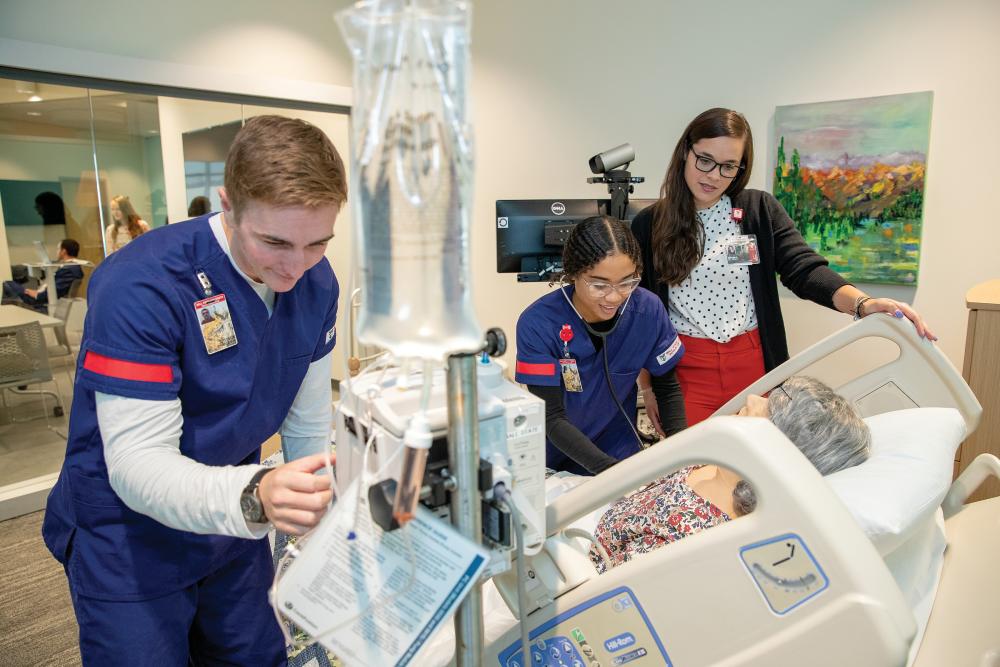
In fact, Ivy Tech’s Richmond campus recently opened a health care simulation center that uses the same equipment and setups you’d find at Reid. “When students make the transition to employment, they don’t have to learn a new system, equipment or even a new room layout,” he says.
Reid Health and Ivy Tech recently partnered to bring medical training rooms to Union City’s Vision Corner Learning Center, which is located downtown and provides students with job-related learning opportunities. High school students can earn dual credit for courses taken and even graduate with certain credentials that enable them to immediately work in the medical field.
Lifestyle Perks
The region has many assets to offer doctors, educators and recent grads. East Central Indiana recently received a $35 million grant through Indiana Economic Development Corp.’s READI program to support quality of life, place and opportunity. There’s currently a large development project in Muncie that includes a new performing arts center and new housing.
“All of this is in an effort to be more attractive to doctors, residents, people who may be working at the hospital, university professors and professionals who have just graduated,” Friedeberg says.
Wayne County has additional housing developments underway as well.
“Housing doesn’t sound glamorous, but it’s needed,” Friedeberg says. “That’s how we capture the people, and that’s how we can retain them, by having the appropriate living accommodations on top of all the great things that our communities already have to offer and the unique charm they have.”
Ivy Tech’s Adaptive Approach
The East Central Indiana region is getting a much-needed boost in health care education, thanks to Ivy Tech Community College’s Muncie campus. With state-of-the-art learning spaces and expanded curricula, Ivy Tech is tackling the pressing challenge of preparing a skilled workforce to meet the region’s growing health care demands.
“Our presence has a lot of impact across the state. Our programs within the School of Nursing as well as in the School of Health Sciences are feeding that pipeline,” says Jeff Scott, chancellor of Ivy Tech Community College Muncie-Henry County. “We’re graduating a few hundred each year, and our School of Health Sciences has enrolled more than 1,000 students for the first time ever. We’re providing our students with valuable skills, and we’re providing personnel to our various health care partners with the hope that we can help our students secure those high-wage, in-demand opportunities and continue to make East Central Indiana even healthier at the same time.”

Key Changes
Recently completed updates to the health sciences facilities and curricula include giving students access to the latest in nursing education technology. Students can learn in mock clinical settings with simulation rooms that are equipped with lifelike mannequins.
“We’ve added new and updated all our simulation mannequins,” says Che’Reese Anderson, dean of the School of Nursing at Ivy Tech’s Muncie campus. “We’ve also added debriefing software that can record our students while they’re doing simulation. Soon, we’ll be adding virtual reality simulation.”
The nursing program also transitioned its curriculum from medical-based teaching to concept-based teaching.
“Clinical judgment was one thing that our clinical partners were telling us that some students were lacking – the ability to know how to go from one step to the next and understand what’s happening to a patient,” Anderson says. “We now have the ability to help the students succeed in that area.”
Get to Know East Central Indiana
Want to learn more about living and working in East Central Indiana? Check out the latest edition of Livability East Central Indiana.